
 The Serviceberry: Abundance and Reciprocity in the Natural World. As Indigenous scientist and author of Braiding Sweetgrass Robin Wall Kimmerer harvests serviceberries alongside the birds, she considers the ethic of reciprocity that lies at the heart of the gift economy. How, she asks, can we learn from Indigenous wisdom and the plant world to reimagine what we value most? Our economy is rooted in scarcity, competition, and the hoarding of resources, and we have surrendered our values to a system that actively harms what we love. Meanwhile, the serviceberry’s relationship with the natural world is an embodiment of reciprocity, interconnectedness, and gratitude. The tree distributes its wealth—its abundance of sweet, juicy berries—to meet the needs of its natural community. And this distribution ensures its own survival. As Kimmerer explains, “Serviceberries show us another model, one based upon reciprocity, where wealth comes from the quality of your relationships, not from the illusion of self-sufficiency.”
Blog
The Vegetable Gardener’s Bible, 2nd Edition: Discover Ed’s High-Yield W-O-R-D System for All North American Gardening Regions: Wide Rows, Organic Methods, Raised Beds, Deep Soil
 The Vegetable Gardener’s Bible, 2nd Edition: Discover Ed’s High-Yield W-O-R-D System for All North American Gardening Regions: Wide Rows, Organic Methods, Raised Beds, Deep Soil. Smith’s legendary high-yield gardening method emphasizes wide rows, organic methods, raised beds, and deep soil. Succeed with fussy plants, try new and unusual varieties, and learn how to innovatively extend your growing season. With thorough profiles of hundreds of popular varieties, The Vegetable Gardener’s Bible provides expert information and an inspiring roadmap for gardeners of all skill levels to enjoy abundant homegrown vegetables.
Teaming with Microbes: The Organic Gardener’s Guide to the Soil Food Web
 Teaming with Microbes: The Organic Gardener’s Guide to the Soil Food Web. When we use chemical fertilizers, we injure the microbial life that sustains plants, and then become increasingly dependent on an arsenal of toxic substances. Teaming with Microbes offers an alternative to this vicious circle, and details how to garden in a way that strengthens, rather than destroys, the soil food web. You’ll discover that healthy soil is teeming with life—not just earthworms and insects, but a staggering multitude of bacteria, fungi, and other microorganisms. This must-have guide is for everyone, from those devoted to organic gardening techniques to weekend gardeners who simply want to grow healthy plants without resorting to chemicals.
Brick and Mortar – Sun and Wind – Here and Now
 There is nothing wrong with communicating by email or searching the internet, but the seductive view that it represents is that the virtual is the same as presence, and that we live with the world at our fingertips. As a mostly “brick and mortar” business, Harlequin’s Gardens would like to invite you to come out and see our actual plants and products and talk with us and ask questions and make a personal connection that can develop over time.
Ornamental Grasses – The Flexible Plant!
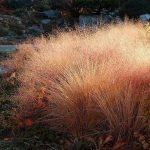
Undaunted Ruby Muhly
We often recognize grasses for their ornamental attributes – textural diversity, dynamic, flowing movement in the breeze, reflecting the dancing light, seasonal transitions, summer screening of unsightly areas, as well as their value in providing food and habitat for wildlife. Large grasses and groupings of smaller ones can share heavily-mulched, low-water, low-maintenance beds with shrubs for plant diversity and visual interest. Grasses also hold the soil, and enrich it, too.
Plant Trees – Save the World

Silver Maple Shade
This week all trees except fruit trees are 30% Off!
There is no doubt that trees help cool the Earth, and they also cool your yard and your city. Even if you don’t have room for a big shade tree, smaller ornamental and fruit trees keep the sun’s rays from striking the soil and warming it. Plants are a good energy investment, because they grow on their own and synthesize food from sunlight. Trees are even a better investment, because of their large photosynthetic capacities and because their value is multiplied over many years. Trees often out-live us, continuing their benefits for our children and the following generations.[Read More]
While it’s Hot, Let’s Plant Cool

chokecherry
Trees are Cool and Harlequin’s Gardens is starting a two week 30% OFF Tree Sale to help with the Cooling. Trees, both the 30’-60’ big shade trees and the 15’-30’ trees are powerful allies for humans both for our survival and for our quality of life. Trees on the west side of the house shade our windows and house from the scorching late afternoon sun, which not only makes our life more pleasant, but also reduces our need for costly air conditioning.
Dealing with Change in the Garden

Shade in Eve’s garden
“The best laid plans of mice and men can still go awry” comes from a 1786 poem entitled “To a Mouse” by Robert Burns. It tells of how he, while ploughing a field, unwittingly upturned a mouse’s nest. The expression was then popularized by the 1937 novel, Of Mice and Men, by John Steinbeck.
Escape to the Tundra

King’s Crown – Rhodiola integrifolia
In early July, Mikl and I always take some time off to celebrate our wedding anniversary, and to escape the Front Range heat. This year, we decided on a stay-cation, with day-trip forays into the high alpine tundra, so easy for us to access from here. Just as spring came early down here at a mere mile above sea level, so it did up in the mountains. In past years, our early July trips to the alpine zone brought us to snowfields in mid-melt, revealing the very first blooms of the tundra – mostly with their feet in the water. [Read More]
Harlequin’s exclusive gifts

Since its inception in 2012, one of our favorite aspects of our Holiday Gift Markets has been the opportunity to highlight the creativity of our own staff. This factor adds immeasurably to the diversity and uniqueness of our market offerings. We hope you’ll be sure to check out each of these “exclusive to Harlequin’s” products!
We welcomed Kate Fain to our staff this season, and she has proved a superb asset to Harlequin’s Gardens. Kate is young, smart, hard-working, and thoroughly besotted with plants and gardening. She has recently entered the degree program in landscape design at Front Range College. On the side, Kate has been dipping her toes in the world of ceramics, experimenting with the lines between function and beauty to create her own unique high-fired stoneware pieces. Her mugs are decorated with bird images, and with wide handles, they invite several fingers to support the cup.
Joleen Smith joined Harlequin’s Gardens staff this spring, bringing with her a continual flow of creativity and artistry, along with her many skill-sets. Have you noticed a lot more helpful and appealing signage at the nursery this year? We have Joleen and Kate to thank! Joleen is a Boulder- based artist known for vibrant, nature-led visuals and community-centered work. We feature the cotton tea towels that Joleen designs, cuts and hand-prints with linoleum blocks, as well as her garden flags that carry images of Sacred Datura flower, Fireweed and Flatirons, and other iconic local natural wonders. These are also carved by hand into linoleum blocks and printed on reused fabric from Boulder’s ArtParts. Hang them in your garden and speak your wishes into the flags. When the wind blows, the fabric threads that eventually wear down and blow away, and the wind will release your wishes into the wild. Joleen has just added some of her other unique and fun designs: hand-painted scenes on vintage vinyl LPs! Come on in and check them out!
 Eric Binkley’s succulent gardens. Driven by his passionate love of outdoor spaces, Eric re-creates natural scenery in living miniature. He has a gift for using low-light tolerant, low-maintenance plants in second-hand ceramics in delightful combinations, making the serenity of the remote outdoors accessible indoors!
Kim Obert is a horticultural therapist. She has been with Harlequin’s Gardens on a part-time basis for some years now, while raising her children. We have a deep appreciation of her gardening experience, plant knowledge, and her skill in helping our customers find just the right plants for their needs. Kim manages our supply of seeds and cheerfully helps wherever help is needed. A key factor in her professional horticultural therapy practice is sensory experience, so it’s only natural that she makes herb salts – a taste treat that will enliven your culinary efforts with the refreshing flavors and aromas of her home-grown organic herbs. Perfect affordable gifts for party hosts, colleagues, and friends.
Eve has been co-owner of Harlequin’s since 2007, and our Holiday Market instigator. Before her work schedule became too demanding, Eve painted botanical illustrations for Botanical Interests seed packets, for private clients, and for the sheer pleasure of examining and revealing the wondrous details of the floral world. Eve’s botanical paintings have been exhibited in Denver, Chicago, and internationally. Recently, in the process of de-cluttering, Eve unearthed her remaining botanical prints, long thought to be sold out. We’re happy to add these prints to our holiday market again!
 Also this year, Eve’s gluten-free, grain-free, sugar-free and delicious pecan Shortbread cookies are back! If you haven’t tried them yet, ask for a small sample. You’ll find these rich and satisfying treats melt in your mouth, based on almond flour, sprouted pecans, and butter, subtly sweetened with a little maple syrup. Gluten-free, grain-free, mostly organic, no refined sugars. You don’t have to be gluten-sensitive to love these rich and satisfying cookies! Shortbread cookies will keep for a long time in your freezer or fridge (as long as nobody discovers them!)
Mikl Brawner is the creator of Harlequin’s Gardens Nursery. He shares two unique products with us again this year. The first is Dr. Brawner’s Healing ……
‘On the Way Home’ is a memoir. Mikl has had a fascinating and adventurous life, and his thoughtful reactions to many formative events have shaped his unique perspectives. In this memoir, with wit, grit and cultural appreciation, he recounts in a series of stories his overland journey from India to England after his two-year Peace Corps service was finished.
Front Range Spotlight: Bob Nold

High and Dry
Sometimes our special events, like our fall plant sales, bring us the extra pleasure of seeing our old friends and mentors. It was a pleasure to have a visit from Robert (Bob) Nold (pictured at the top of the Newsletter with a cart full of xeric native plants -– Chilopsis and Brickellia) last weekend. Bob has been both a friend and a mentor for decades, and an influential pioneer of gardening with xeric native plants, many of which were, at that time, unknown to horticulture. Bob also championed gardening on the Front Range with little or no supplemental water.
Together with his wife Cindy Nelson Nold, a prominent botanical illustrator and photographer, Bob created xeric gardens on their property in a Denver suburb, where Bob says it almost never rains. Bob and Cindy also produced three invaluable and beautifully illustrated volumes that were published by Timber Press. The first was Penstemons, a comprehensive classification and
descriptive guide to North America’s largest endemic plant genus. This was followed by Columbines, a similarly rich and important guide to a diverse and garden-worthy genus, and High and Dry: Gardening with Cold-hardy Dryland Plants. In this book, Bob makes us aware of
great plants of the interior west that are accustomed to scorching, dry summers and cold, windy winters without prolonged snow-cover. Many of these plants were not yet available to gardeners and some are still hard to find. From the book jacket: “Leavened with
humor and rueful wisdom, Nold’s pithy descriptions zero in on each plant’s outstanding ornamental characteristics while giving the reader an accurate idea of what to expect from the plant’s performance in the garden.”
Unfortunately, all three of these books are long out-of-print. There may occasionally be used copies of the original publications available at independent book stores, and we highly recommend that you try to acquire them. On-demand, hard-cover printings in black and white are also available from
Hachette Publishing.
YUCCA EXTRACT: Ordinary magic for drought stress and water and nutrient absorption

Sledge Hammer
Yucca glauca is our local native yucca. The common name is Soapweed, because native Americans used the roots to make soap. Harlequin’s Gardens has been using an extract of Yucca schidigera, Mojave Yucca, in our plant production for 30 years. Yucca roots are high in saponins which are plant chemicals that are both water and fat soluble. In nature, the saponins enhance nutrient absorption and serve as antifeedants to reduce pest damage.
The yucca product that we carry for our customers has the terrible name ‘Sledgehammer’, because it breaks down salts from high fertilizer use. We offer it for its natural function to release the surface tension of water which greatly helps water absorption into the soil and into the roots and through the cell walls of plants. These effects are particularly useful in helping seeds to germinate and helping drought-stressed plants absorb water and more quickly recover from dehydration.
The label says that Sledgehammer is just yucca. Use it at two teaspoons per gallon of water in normal watering.
We routinely use yucca extract as an emulsifier and ‘sticking’ agent whenever we are applying any kind of spray to plant foliage. This includes foliar feeding, horticultural oil sprays for pest management, or liquid kelp spray for toughening the leaf cuticle to block disease spores.
Mikl figured that if yucca helps with water absorption, then it could help with dehydration that comes with working outside and forgetting to drink water, so he takes one yucca capsule (made by NOW) a day. Yucca has the added benefit of improving nutrient absorption and reducing joint pain. It is said to improve digestion and support gut health.
Late Summer is Strawberry Planting Time

Why grow your own strawberries? Unfortunately, commercially-farmed strawberries are one of the crops most heavily sprayed with toxic pesticides. In addition, you will probably never taste truly delicious, sweet, fully ripe strawberries unless you grow them yourself. So, if you’re tired of paying high prices for unripe, bland, oversized strawberries with white flesh, maybe it’s time to do just that.
June-Bearing varieties provide a concentrated crop with large harvests throughout June, good for making preserves, strawberry shortcakes, etc. Ever-bearing and ‘day-neutral’ varieties produce small but more continuous crops through the summer, good for snacking.
Why plant them now? This might surprise you: strawberry plants set their buds in the winter for flowering and fruiting the following summer. So the plants you put in now will bear fruit sooner than if you wait until spring to plant. Each strawberry plant can bear fruit for five or six years if properly managed. Planting new strawberry plants now can give you an excellent berry crop in 2027 if you follow a few basic instructions.
1. Plant 6 to 8 weeks prior to average first hard freeze.
2. Choose a location that receives 6 to 8 hours of full sun.
3. Prepare planting bed: Soil should be loose, well-drained, rich and moist, with compost mixed in. If using composted manure, make sure it does not have a highly alkaline pH. Strawberries thrive best in slightly acidic soils with pH of 5.5 to 6.5, which is hard to achieve here (our native soils and our water tend to be alkaline). The addition of soil life through mycorrhizal inoculation, compost and compost tea, helps mitigate the negative
effects of alkalinity by making minerals available to plants. Compost also helps with moisture retention. Adding some Worm Compost will increase phosphorus and potassium, and to improve soil moisture retention and aeration and enhance beneficial microbe habitat, incorporate a 1” to 2” layer of expanded shale along with the compost.
4. Do not fertilize strawberry plants at planting time.
5. Remove all runners from plants by snipping off with clean pruners. As plants grow, continue to remove runners as soon as they appear. In about their fifth year, you can allow a few runner to develop and replace older plants.
6. Strawberry roots are shallow and lateral, requiring only about 6” soil depth. Set plants 18” to 24” apart. Do not bury the crown or set it too high. The crown is the point from which all of the leaf stems emerge. It should be right at the level of the soil prior to mulching.
7. Mulch with straw or dried, seed-free grass clippings.
8. Fertilize June-bearing strawberries like ‘Early-Glow’ in early autumn with a balanced, granular, slow-release organic fertilizer such as Happy Frog All-Purpose (6-4-5), Down ToEarth Vegetable Garden fertilizer 4-4-4), or their Acid Mix. Fertilize ever-bearing and day-neutral varieties when their fruiting season has ended.
9. Be sure to water strawberry plants in winter. Dig down 2” to check for moisture.
10. While fruiting, protect your strawberry bed from critters like deer, squirrels, raccoons and birds.
11. Top-dress in fall with a thin layer of compost.
How to Plant in July
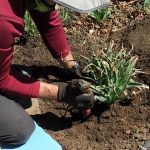
How To Plant in July And Keep Your Gardens Alive!
1) Before planting , prepare the soil by adding 2″ of compost and dig it into the to top 6″-8″ of soil OR Add 1″-2″ of expanded shale with the compost, then dig it in. This will open clay soil, increasing both porosity (aeration) and water holding capacity. Set the prepared soil aside.
Harlequin’s Gardens Pollinator Garden
We are in the last week of Pollinator Month. We still have a lot of good pollinator perennials and shrubs. Our pollinator garden is looking beautiful and many plants have labels. This garden was given a boost last spring by a grant from People and Pollinators Action Network, plus a lot of Harlequin’s plants. Last Saturday Mikl led a tour of the garden for the Garden Conservancy a national nonprofit working to share and celebrate America’s gardens.
SEED LIST for CONGRESS PARK NATIVE MEADOW PLANTINGS

Seeded Wildflower Meadow
Allium cernuum – Nodding Onion (perennial)
Antennaria parviflora – Pussytoes (perennial)
Aristida purpurea – Purple Three-awn ( bunch grass)
Artemisia frigida – Fringed Sage (perennial)
Bouteloua gracilis – Blue Grama (grass)
Callirhoe involucrata – Wine Cups (perennial)
Castilleja integra – Paintbush (perennial)
Dalea purpurea – Purple Prairie Clover (perennial)
Erigeron speciosus – Showy Fleabane (perennial)
Eriogonum jamesii – Antelope Sage (perennial)
Erysimum capitatum – Wallflower (biennial)
Euphorbia marginata – Snow on the Mountain (annual)
Festuca arizonica – Arizona Fescue (bunch grass)
Gaillardia aristata ‘Meriwether’ wild form – Blanketflower (perennial)
Geum triflorum – Prairie Smoke (perennial)
Ipomopsis rubra – Scarlet Gilia (biennial)
Koeleria macrantha – Junegrass (bunchgrass)
Liatris punctata – Dotted Gayfeather (perennial)
Linum lewisii – Native Blue Flax (perennial)
Monarda citriodora – Lemon Bergamot (annual)
Monarda punctata – Spotted Bergamot (annual)
Oenothera caespitosa – Tufted Evening Primrose (perennial)
Penstemon superbus – Superb Penstemon (perennial)
Penstemon barbatus coccineus – Scarlet Bugler
Pulsatilla vulgaris – European Pasqueflower (non-native perennial)
Ratibida columnifera pulchella – Red Prairie Coneflower (biennial)
Sphaeralcea coccinea – Scarlet Globemallow (perennial)
Symphyotrichum ericoides – Heath Aster (perennial
Thelesperma filifolium – Greenthread (biennial)
Zinnia grandiflora – Prairie Zinnia (perennial)
Note: most, but not all species germinated. No-shows include Sphaeralcea coccinea, Eriogonum
jamesii, Allium cernuum.
A Native Meadow Grows in Denver
Seeded Wildflower Meadow
In June, Mikl and I attended the annual Plant Select conference, where an award was presented to the project designers, supervisors Julie Lehman and Holly Shields of Denver City Parks for their very successful seeded native wildflower meadow on the Josephine Street side of Congress Park and along 8th Avenue where it borders the park. When the conference was over, we headed over there to check it out. We were impressed! In June the parking strips were vibrant with flowers and pollinators, The garden had been seeded two years before and was lush and full, with grasses, flowering annuals, perennials and biennials filled in and blooming profusely.
The project was conceived as a demonstration garden that could inspire Denverites to replace lawns with low-water native pollinator habitat that would require very little maintenance. I met yesterday with Julie and Holly for a tour and to gain an understanding of the process that created such a successful result. I found the meadow plantings more subdued in color than they were in summer, but just as rich in fullness, texture and detail.

Holly and Julie
Both Julie and Holly were already familiar with our native wildflowers, but hadn’t attempted a project like this before. After researching plant characteristics and seed availability, the project designers selected 32 local and regional native species that they thought could thrive together in with the same sun exposure, soil conditions, and watering regime, and not grow too tall for street-side planting. The seeds of many native plants have evolved to require a period of cold conditions to break the dormancy of their seeds, so their selections also had in common the need for their seeds to be cold-stratified for a similar length of time. See their seed list here. Julie points out that ‘So much of this is what you would do with regular seeding of a lawn, same irrigation, same protocols. You could make a seed mix that doesn’t need cold strat, and add the plants that do need stratification by buying them at local nurseries and ‘plugging’ them in.” And Harlequin’s Gardens suggests that you can start your seeded meadow by direct-seeding in the fall and allowing cold winter temperatures do the cold-stratification for you.
 The project began with killing the bluegrass turf in the project areas. They chose to use two applications of glyphosate, a product that we at Harlequin’s Gardens cannot promote because of its toxicity to humans, wildlife and soil life. Instead, we recommend several non-toxic options, including mechanical sod-stripping, solarizing, and sheet mulching.

Meadow in June
Next, a sod-cutter was used to cut out the dead turf and roots to a depth of 3”, leaving a level-bottomed “trench”, which was then filled with a gravel mixture of 75% ‘crusher fines’ and 25% gray ‘rock chips’.
In the meantime, the seeds were all mixed together with vermiculite and cold-stratified in the city’s refrigerated facilities. When they were ready in June, a seed-spreader was used to sow them into the gravel, making multiple passes with light applications to distribute the seed as evenly as possible. This was followed by raking the seeds in with a metal fan-rake so they would all fall beneath the surface. The seedbeds were watered thoroughly, and watering continued daily until there were a good number of seedlings showing up, which took one and a half to two weeks. A crew of trained volunteers or interns regularly pulled out weed seedlings as the plants developed.

Meadow in Congress Park
With an automatic pop-up irrigation system already installed, the meadow areas were, and still are, watered once every two weeks through the growing season.
Another of the project’s goals was to make this approach work for busy gardeners with little time for maintenance. All seeds are allowed to drop, and the gardens are mowed once in December, with the cut materials left on the garden surface (we at Harlequin’s Gardens would recommend leaving the stalks standing until March or early April so that beneficial insects and their eggs are not disturbed). Ongoing maintenance includes weeding regularly.
Kudos to Julie Lehman and Holly Shields and City of Denver Parks! We hope you’ll go and see these gardens, hopefully in more than one season. They provide an excellent model for a way to garden for saving water, money, time and effort, creating beauty, and creating pollinator and habitat. You can easily add new plants into this kind of garden by planting compatible nursery-grown specimens into the meadow.
Some Like it Hot!

Marconi Rosso
Peppers have really thrived in this summer’s high heat. I’ve had my best yields ever of Marconi Rosso, Lanterna Piccante, Alma Paprika and Habanada peppers., and they continue to produce more fruits.
Marconi Rosso, like other Italian ‘frying’ peppers make an easy and incredibly delicious side-dish for a Mediterranean-style dinner: simply remove seeds, cut into strips vertically, sprinkle with sea salt and saute in good olive oil over medium heat, turning occasionally until softened (about 7 minutes). Serve as-is, or garnish with toasted pine-nuts or shredded Pecorino cheese.

Lanterna picante
Lanterna Piccante is a unique pepper that you won’t find in stores or even at farmers Markets. The large plants are graceful and bear large numbers of stunning pendant scarlet fruits, 1.5” to 2.5” across, shaped like succulent nodding bells. These are thin-walled, with the flesh having a delicious fruity flavor, and the seeds and ribs packing significant heat. The heat dissipates very quickly and doesn’t linger long on the tongue. To avoid the heat, cut the peppers in half vertically and cut out the seed cluster and ribs. Save a few seeds to add a little spark back to dishes that contain the flesh. I love to chop Lanterna Piccante peppers into 1/4” ‘confetti’ and add to omelettes, stir-fries, chicken or tuna salad, for its flavor and beauty. With the seeds, or some of them, it makes a great salsa ingredient. Like other peppers, they freeze well.

Alma paprika
I love growing Alma Paprika for the fun of watching the fruits change color as they mature, starting out creamy white, becoming marbled and flushed with rosy shades, and finally ripening to vibrant solid red. The distinctive flavor is a little spicy but not hot, perfect for making your own sweet paprika seasoning. I but the fruits into ½” squares and slowly dry them in my dehydrator. I grind the pieces in an electric coffee grinder (that is only used for spices), and store in a glass jar.
This is the first time I’ve grown Habanada pepper, a newer hybrid that is supposed to have all the flavor of a classic Habanero pepper bit completely without heat. One fruit on my plant is approaching ripeness now, and I’m looking forward to trying it.
Storing Seeds – Four Tips to Prolong Viability

Because seeds are alive, they inevitably lose viability due to environmental factors. Leaving your seed packets outside in the sun on your potting bench, in your car, or on your kitchen table will negatively impact their viability. By keeping them in a steady environment, you will prolong their ability to grow successfully in your garden.
1. Maintain Cool Conditions. Store out of direct sunlight in a cool spot that maintains a fairly consistent temperature.
2. Maintain Dark Conditions. Sunlight is a signal that it is time to sprout, so it is important that they live in a dark room or a refrigerator.
3. Maintain Dry Conditions. Make sure that you don’t store them in a spot that is too humid where they may sprout or mold. If seeds are too wet, they can rot in the refrigerator. If you store seeds in the refrigerator or freezer, place the packets in an air-tight container and ensure the seeds are properly dried to begin with.
4. Protect the Seeds. Critters, rodents and bugs may enjoy tasting your seeds so it is important to store them in proper containers. This could be glass jars, ziplocks, metal containers, or plastic pill bottles. We store our seeds in paper envelopes or bags kept in critter-proof storage boxes.
Purchased seeds will store just fine in the envelope they came in, plus retail seed packets have all the information necessary for planting and caring for the seeds.
Seed saving class this weekend with Jess Harper will teach you to save your own home-grown seeds. Sign up here!
Water-Wise Plants for a No-Water Garden
In our 35 years of experience gardening on our two-acre property in the rocky short-grass prairie in far-north Boulder, CO, we have found the plants listed here to grow successfully without supplemental watering once established. The early years of the gardens were blessed with more natural precipitation than we are experiencing now. Some plantings receive more attention than others, but these plants have all managed without irrigation for long stretches of time.
Acer negundo Boxelder Maple
Agave parryi Parry’s Agave
Allium tuberosum Garlic Chives
Argemone polyanthemos Prickly Poppy
Artemisia filifolia Sand Sage
Artemisia frigida Fringed Sage
Artemisia ludoviciana Silver King Artemisia
Artemisia tridentata Big Sage
Buddleia alternifolia argentea Silver Butterfly Bush
Celtis occidentalis Western Hackberry
Celtis reticulata Netleaf Hackberry
Cercocarpus intricatus Littleleaf Mt. Mahogany
Cercocarpus ledifolius Curlleaf Mt. Mahogany
Cercocarpus montanus Trueleaf Mt. Mahogany
Chamaebatiaria millefolium Fernbush
Cleomella serrulata Rocky Mt. Bee Plant
Cotinus ‘Grace’ ‘Grace’ Smoketree
Cotoneaster lucidus Hedge Cotoneaster
Cotoneaster racemiflorus var. soongoricus – Redbead Cotoneaster
Crataegus ambigua Russian Hawthorn
Crataegus phaenopyrum Washington Hawthorn
Cupressus arizonica Arizona Cypress
Ericameria nauseosa Tall Blue, Tall Green and Dwarf Blue
Fallopia aubertii Silver Lace Vine
Foeniculum vulgare Purpureum Bronze Fennel
Forestiera neomexicana Desert Olive
Glaucium acutidentatum Horned Poppy
Gleditsia triacanthos Honeylocust
Helianthus annuus Common Sunflower
Helianthus salicifolius Willow Leafed Sunflower
Iris germanica Bearded Iris
Juniperus monosperma One Seed Juniper
Juniprus scopulorum Rocky Mt. Juniper
Koelreuteria paniculata Golden Rain Tree
Limonium gmelinii Siberian Statice
Linum lewisii Native Blue Flax
Mahonia aquifolium Oregon Grape Holly
Mahonia fremontii Desert Holly
Malus other apples
Malus Royalty Royalty Crab
Marrubium cyllenaum Greek Horehound
Marrubium rotundifolium Silver Edged Horehound
Morus tatarica Hardy Mulberry
Penstemon Many species
Philadelphus coronarius Sweet Mock Orange
Pinus edulis Pinyon Pine
Pinus ponderosa Ponderosa Pine
Prunus americana American Plum
Prunus virginiana Canada Red Chokecherry
Prunus virginiana Chokecherry
Rhus glabra cismontane
Rhus trilobata Threeleaf Sumac
Rocky Mt. Sumac
Rosa eglanteria Sweetbrier Rose
Rosa Fruhlingsgold Spring Gold Rose
Rosa Henry Kelsey Henry Kelsey Rose
Rosa John Davis John Davis Rose
Rosa moyesii Eddy’s Jewel Rose
Sedum many varieties
Sphaeralcea fendleri Tall Globemallow
Syringa vulgaris Common Purple Lilac
Tanacetum parthenium Feverfew
Yucca baccata Banana Yucca
Yucca glauca Plains Yucca
Native Plants in Display Gardens for 5-7 Waterings Per Year
The native plants listed here have all been grown successfully in gardens here that were watered only 5 to 7 times per year. We amend our rocky soils when planting. Gardens vary in amounts and timing of sun exposure. Our definition of ‘native’ is broad, and includes plants from our specific locale, the state of Colorado, and the arid, temperate steppe, foothill, montane and alpine regions of the Rocky Mountain states and the southwest.
Achillea lanulosa (Achillea millefolium var. lanulosa) (Yarrow)
Agave parryi neomexicana (New Mexico Century Plant)
Amelanchier alnifolia (Serviceberry)
Amorpha canescens (Leadplant)
Amorpha fruticosa (False Indigo)
Amorpha nana (Dwarf Leadplant)
Amsonia jonesii (Jones’ Bluestar)
Andropogon gerardii ‘Pawnee’ (Pawnee Big Bluestem)
Andropogon saccharoides (Silver Beard Grass)
Aquilegia barnebyi (Barneby’s Columbine)
Aquilegia caerulea (Rocky Mt. Columbine)
Aquilegia chrysantha (Yellow Columbine)
Arenaria hookeri (Sandwort)
Argemone polyanthemos (Prickly Poppy)
Artemisia campestris (Wild Tarragon)
Artemisia filifolia (Sand Sage)
Artemisia frigida (Fringed Sage, Silver Sage )
Artemisia ludoviciana (Silver King Artemisia)
Artemisia nova (Black Sage)
Artemisia tridentata syn. Seriphidium tridentatum (Western Big Sage)
Artemisia tripartita(Cutleaf Big Sage)
Aster ericoides (Wreath Aster)
Aster fendleri ‘My Antonia’ (‘My Antonia’ Rock Aster)
Aster obligifolius (Aromatic Aster)
Aster sericeus (Silky Aster)
Atriplex canescens (Four-wing Saltbrush)
Atriplex confertifolia (Spring Saltbrush)
Baptisia australis minor (Dwarf False Blue Indigo)
Blepharoneuron tricholepis (Pine Dropseed)
Bouteloua curtipendula (Side Oats Grama)
Bouteloua gracilis (Blue Gramma)
Callirhoe involucrata (Wine Cups)
Calylophus serrulatus (Sundrops)
Ceanothus fendleri (Buckbrush)
Cerastium arvense (Field Mouse Ear)
Ceratoides lanata (Winterfat)
Cercocarpus intricatus (Dwarf Mountain Mahogany)
Cercocarpus ledifolius (Curl-leaf Mountain Mahogany)
Cercocarpus montana (Mountain Mahogany)
Chamaebataria millefolium (Fernbush)
Chilopsis linearis (Desert Willow)
Chrysothamnus nauseosus nauseosus (Dwarf Rabbitbrush)
Clematis ligusticifolia (Western Virgin’s Bower)
Coryphantha missouriensis
Crataegus douglasii (Douglas Hawthorn)
Cupressus arizonica (Arizona Cypress)
Cylindropuntia imbricata (Cholla, Candelabra Cactus)
Cylindropuntia whipplei (Whipple’s Cholla)
Datura wrightii (D. meteloides) (Sacred Datura)
Echinacea tennesseensis (Tennessee Coneflower)
Echinocereus caespitosus
Echinocereus reichenbachii (Lace Cactus)
Echinocereus triglochidiatus (Claret Cup Cactus)
Echinocereus viridiflorus
Eragrostis trichodes (Sand Love Grass)
Erigeron flagellaris (Whiplash Daisy)
Eriogonum heracleifolium
Eriogonum jamesii flavescens
Eriogonum niveum niveum
Eriogonum ovalifolium
Eriogonum umbellatum (Sulphur Flower)
Eriogonum umbellatum ‘Kannah Creek’
Eriogonum umbellatum subalpinum
Eriogonum wrightii wrightii (Wright’s Sulfur Flower)
Escobari vivapara
Fallugia paradoxa (Apache Plume)
Fendlera rupicola (Cliff Fendler Bush)
Forestiera neo-mexicana (New Mexican Privet)
Gaillardia aristata (Indian Blanket Flower)
Geranium fremontii (Fremont Geranium)
Geranium richardsonii (Richardson Geranium)
Gilia aggregata (Scarlet Gilia)
Gutierrezia sarothrae (Snake Weed)
Helianthus pumilus (Dwarf Sunflower)
Hesperaloe parviflora (Texas Red Yucca)
Humulus lupulus neomexicana (Wild Hop Vine)
Hymenoxys scaposa (Perky Sue)
Juniperus monosperma (Single-seed Juniper)
Juniperus scopulorum (Rocky Mt. Juniper)
Leucocrinum montanum (Sand Lily)
Liatris punctata (Gayfeather, Blazing Star)
Linum lewisii (Native Blue Flax)
Lithospermum multiflorum (Many-flowered Pucoon)
Lomatium orientale (Native Parsley)
Mahonia fremontii (Fremont’s Mahonia)
Mentzelia decapetala (Blazing Star)
Mirabilis multiflora (Desert Four-O’Clock)
Nolina microcarpa (Beargrass)
Oenothera caespitosa (Tufted Evening Primrose)
Oenothera howardii (Howard’s Evening Primrose)
Oenothera mac. Incana ‘Silver Blade’
Opuntia fragilis (Fragile Prickly Pear)
Opuntia polyacantha (Yellow Prickly Pear)
Oryzopsis hymenoides (Indian Rice Grass)
Oxytropis lambertii (Lambert’s Locoweed)
Panicum virgatum ‘Shenandoah’ (Red Switchgrass)
Pediocactus simpsonii (Mt. Ball Cactus)
Penstemon alamosensis
Penstemon ambiguous
Penstemon angustifolius
Penstemon arenicola
Penstemon barbatus ‘Coccineus’
Penstemon buckleyi
Penstemon cardinalis
Penstemon clutei
Penstemon cyananthus
Penstemon davidsonii
Penstemon gormanii gormanii
Penstemon grandiflorus
Penstemon havardii
Penstemon linarioides coloradoensis
Penstemon mensarum
Penstemon palmeri
Penstemon procerus
Penstemon pseudospectabilis
Penstemon rostriflorus (Bridges Penstemon)
Penstemon secundiflorus (Sidebells Penstemon)
Penstemon strictus (Rocky Mt. Penstemon)
Penstemon teucroides
Penstemon virens
Penstemon virgatus ssp. asa grayii
Pinus edulis (Pinyon Pine)
Pinus ponderosa (Ponderosa Pine)
Populus tremuloides (Quaking Aspen)
Prunus americanus (Wild Plum)
Prunus besseyi (Western Sand Cherry)
Prunus besseyi ‘Pawnee Buttes’ (Dwarf Sandcherry)
Prunus virginiana (Chokecherry)
Ptelea trifoliata (Wafer Ash, Hop Tree)
Quercus gambelii (Gambel Oak)
Quercus undulata (Wavy Leaf Oak)
Rhus trilobata (Lemonade Bush, Skunkbrush)
Ribes aureum (Golden Currant)
Ribes cereum (Wax Currant)
Ribes odoratum ‘Crandall’ (Crandall Clove Currant)
Rosa acicularis (Arctic Rose)
Rosa arkansana
Rosa woodsii (Woods Rose)
Schizachyrium scoparium ‘The Blues’ (Little Bluestem)
Sedum lanceolatum (Lanceleaf Stonecrop)
Senecio spartioides (Grassleaf Senecio)
Shepherdia argentea (Silver Buffaloberry)
Silene regia (Royal Catchfly)
Solidago nana (Dwarf Goldenrod)
Sorghastrum nutans (Indian Grass)
Sphaeralcea coccinea (Cowboy’s Delight; Scarlet Globemallow)
Sphaeralcea incana (Globe Mallow)
Sporobolus airoides (Alkali sacaton)
Sporobolus heterolepis (Prairie Dropseed)
Sporobolus wrightii (Wright’s Sacaton)
Tradescantia occidentalis (Western Spiderwort)
Yucca baccata (Banana Yucca)
Yucca glauca (Narrowleaf Soapweed)
Yucca harrimanii (Dollhouse Yucca)
Non-Native Plants in Display Gardens for 5-7 Waterings Per Year
The plants listed here have been grown successfully in our display gardens and in other locations around our 2-acre property for long periods of time, receiving only 5 to 7 waterings per year.
Acantholimon glumacium
Acantholimon hohenackeri
Acantholimon litwanovii
Achillea ‘Moonshine’
Achillea ageratifolia (Greek Yarrow)
Achillea kellereri (Keller’s Yarrow)
Achillea serbica (Serbian Yarrow)
Aethionema ‘Warley Rose’
Agave parryi neomexicana
Alba Suaveolens-rose
Alchemilla mollis (Ladies Mantle)
Allim schoenoprasum (Chives)
Allium tuberosum (Garlic Chives)
Allium senescens glaucum
Allium sphaerocehalum (Drumstick Allium)
Alyssoides graeca (Greek Bladderpod)
Ampelopsis brevipedunculata maxim…..
Arabis caucasica
Arenaria montana
Arp Rosemary
Artemisia ‘Powis Castle’
Artemisia ludoviciana ‘Valerie Finnis’
Aubrieta ‘White Wall Gem’
Aubrieta deltoides ‘Purple Gem’
Aurinia saxatilis (Basket of Gold)
Berggarten Sage
Betonica foliosa
Brunnera macrophylla (Perennial Forget-me-Not)
Buxus ‘Julia Jane’
Buxus microphyllus koreana
Campanula garganica
Caryopteris x clandonensis (Blue Mist Spirea)
Catananche caerulea (Cupid’s Dart)
Centaurea bella
Centauria cyanus ‘Emperor William’ (Blue Bachelors Button)
Ceratostigma plumbaginoides (Plumbago)
Champlain-rose
Clematis ‘Niobe’
Clematis ‘Prairie Traveller’s Joy’
Clematis recta
Complicata-rose
Constance Spry-rose
Corydalis ochroleuca
Cyclamen hederifolium (Hardy Cyclamen)
Darlow’s Enigma-rose
Desiree Parmentier-rose
Dianthus freynii
Dianthus gratianapolitanus ‘Tiny Rubies’
Dianthus petraeus noeanus
Dianthus Tuscan Honeymoon
Dortmund-rose
Ephedra viridis
Eriogonum umbellatum ‘Kannah Creek’
Eriogonum heracleifolium
Eriogonum ovalifolium
Erodium chrysanthum
Escholzia californica (California Poppy)
Euonymus fortunei ‘Minima’
Foeniculum vulgare (Bronze Fennel)
Fruhlingsgold-rose
Geranium cinerium ‘Ballerina’
Geranium macrorrhizum
Geranium macrorrhizum from Bulgaria
Geranium robertianum (Herb Robert)
Geranium sanguineum
Geum triflorum (Prairie Smoke)
Glaucium acutidentatum (Horned Poppy)
Golden Wings-rose
Harrison’s Yellow-rose
Helianthemum grandiflorum
Helianthemum nummularia
Helleborus orientalis (Lenten Rose)
Hemerocallis (unknown)
Henry Kelsey-rose
Heuchera ‘Firefly’
Heuchera sanguineum (Coral Bells)
Iberis sempervirens (Evergreen Candytuft)
Iberis sempervirens ‘Little Gem’ (Dwf. Evergreen Candytuft)
Iris orientalis
John Cabot-rose
John Davis-rose
Koelreuteria paniculata (Golden Rain Tree)
Lavandula angustifolia Munstead, Hidcote
Lavandula intermedia Grosso
Limonium gmelinii Siberian Statice
Linum flavum (Yellow Flax)
Lonicera japonica ‘Halliana’ (Hall’s Honeysuckle)
Lychnis coronaria (Rose Campion)
Lysimachia punctata (Yellow Loosestrife)
Malva sylvestris mauritianum (Magic Hollyhock)
Marrubium cyllenium
Marrubium rotundifolium
Myrrhis odoratus (Sweet Cecily)
Onosma echioides
Oreganum ‘Hopley’s Purple’
Oreganum vulgare (Oregano)
Origanum vulgare ‘Norton’s Gold’
Othello-rose
Parkdirektor Riggers-rose
Paxistima canbyi Mountain Lover
Penstemon many species
Phlox subulata ‘Boothman’s Variety’
(Boothman’s Creeping Phlox)
Phlox subulata ‘Millstream Jupiter’
Picea glauca ‘Conica’ (Dwarf Alberta Spruce)
Polygonum aubertii (Silver Lace Vine)
Potentilla argentea
Rosa foetida bicolor (Austrian Copper Rose)
Rosa glauca (Red-leaf Rose)
Rosa moyesii ‘Eddy’s Jewel’
Rose de Rescht
Ruta graveolens (Rue)
Salvia sclaria (Clary Sage)
Sambucus nigra (Black Elderberry)
Santolina chamaecyparris (Grey Santolina)
Saponaria lempergii ‘Max Frei’
Scabiosa lucida Fairy Pincushion
Scutellaria orientalis
Sedum ‘Bronze Carpet’
Sedum ‘Morchen’
Sedum album
Sedum seiboldii
Sedum rupestre (Pinetree Sedum)
Sedum spectabilis ‘Autumn Joy’
Sedum spectabilis ‘Indian Chief’
Sedum spurium ‘Dragon’s Blood’
Sempervivum ‘Ohio Burgundy’
Sempervivum arachnoides
Sisyrinchium macrocarpum
Sphaeralcea fendleri
Spirea bumalda ‘Goldflame’
Spirea ‘Cheyenne Snowmound’
Stachys byzantina (Lambs Ears)
Tanacetum densum var. amani
The Fairy-rose
The Gift-rose
Thymus (many creeping forms)
Thymus baeticus
Veronica allioni
Veronica armena
Veronica cuneifolia
Veronica liwanensis (Turkish Veronica)
Veronica macrostachya, silver form
Veronica oltensis
Veronica pectinata
Veronica prostrata
Wisteria macrastachya Aunt Dee Wisteria
Recipe for Quinoa Tabbouleh

Tabbouleh is one of my favorite summer dishes. When the tomatoes and cucumbers are coming in from the garden daily, there is no better time to enjoy this delightful dish that is bursting with the flavors of summer. It can serve as the main dish or it can accompany falafel or baked chicken. I have yet to find a better use for parsley as well! This recipe is gluten-free and easy to adapt to your tastes, depending on what you like.
Ingredients:
1-2 bunches of parsley, washed and de-stemmed
1 bunch of peppermint
4-5 scallions, chopped
1-2 garlic cloves, chopped
1/2-3/4 cups EVOO
1/2 cup fresh lemon juice
2-4 medium tomatoes, chopped
1 cucumber, chopped
1 cup dry quinoa
salt and pepper to taste
(optional: feta, kalamata olives, lightly toasted blanched slivered almonds)
Instructions:
Make quinoa according to package directions.
Add parsley, mint, green onions, and garlic, to a food processor (or chop by hand). Chop until herbs are very fine.
In a bowl, first drizzle the olive oil over the cooled quinoa, mix well. Follow with the lemon juice. Mix to combine. Then add herb mixture, diced tomatoes, cucumbers, and optional additions. Mix well. Salt and pepper to taste. Enjoy summer in a bowl!
Serves 4 (Reduce Quinoa to 1/2 cup for 2 people)
Photo by Elias Rodriguez on Unsplash
Preventing Tick-borne Diseases

A warming climate has led to larger populations of ticks and rodents, and southern ticks have expanded northward. The most prevalent tick-borne disease is Lyme Disease (Lyme borreliosis). But Lyme disease cases originating in Colorado are extremely rare, as the black-legged tick that carries the disease is not established in Colorado. The main dangers from ticks here are that they may be carrying Colorado Tick Fever and Tick-borne Relapsing Fever. Cases of Rocky Mountain Spotted Fever are rare in Colorado, but not unheard-of.
Tick season typically begins in April and peaks in spring and early summer. Most ticks on humans are found crawling between the ankle and knee. Apply a natural repellent like ‘Repel’ (a lemon-eucalyptus formula) or ‘No-Bite-Me’ (a multi-herbal cream) to exposed skin and the most vulnerable areas. Wearing tall socks can prevent tick penetration. Tucking pant-legs into
the tops of your socks also helps keep ticks out. Ticks are usually dark, and show up best on light-colored clothing. Ticks can drop down from trees as you pass under them, so wear a hat and long sleeves as well as long pants. Dogs frequently return from walks and hikes with ticks and require thorough inspections before re-entering the house, or your car. Eve, who doesn’t have a dog, once found a tick on her pants-leg while working in her vegetable garden. Garlic-based ‘Mosquito Barrier’ is said to reduce tick populations in the landscape by 50%.
As soon as you get home after a walk or hike in grassy or forested areas, run your clothing in the dryer on the high-heat setting and take a shower, checking for ticks – especially in arm-pits, groin, back, neck and scalp. If you find a tick that has already attached itself, remove it as soon as possible. To remove a tick, use one of our handy ‘Tick Keys’, or use tweezers to gently and slowly pull straight up on the tick. Do not squeeze the tick body in the tweezer or crush the head. If using your fingers, cover them first with a tissue. Do not use alcohol, a hot needle, or gasoline to attempt removal. Save the dislodged tick in a small, closed jar in case you develop symptoms and need to identify the infection.
(Photo courtesy Erik Karits on Unsplash)
Amorpha fruticosa – False Indigo A Versatile Native Shrub
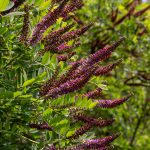
Amorpha fruticosa – False Indigo A Versatile Native Shrub
Leadplant has a little brother, Amorpha nana, but did you know that it also has a big sister? Like its kin, False Indigo is deciduous, and is a legume with deep branching roots that fix nitrogen from the air, enriching the fertility of the soil around it. You’ll find it growing in areas with relatively high water-tables or periodic flooding, such as Walden Ponds in east Boulder County.
Grown in full sun, it makes a densely twiggy and fine-textured shrub to about 4’ tall and wide, and grown under tall trees or in places shaded by high walls, it will be graceful, open and airy, and taller – up to 12’x 8’. Slender, smooth stems are gray, and the pinnately compound foliage is fine-textured, with dark green ½”-long oval leaflets that turn bright gold in autumn. The showy blooms arrive in late May or June, arranged in finger-like tapering spikes of tiny dark blue-purple florets with conspicuous orange stamens. These are visited by butterflies for their nectar, and bees as well, for pollen and nectar. Small bean pods ripen in late summer and autumn, and are enjoyed by many birds. False Indigo is cold-hardy to -30F, fast-growing and long-lived. It’s not fussy about soil, and tolerates high heat as long as it is receiving some moisture. Once it has built a good root system, False Indigo should thrive with two deep waterings per month. A lovely companion to Silver Buffaloberry, Golden Currant, Rocky Mountain Maple, Chokeberry, and New Mexico Privet.
Heat! What’s it Good For?

There’s only one thing I can think of that extreme heat is good for, and that is killing plants. And every so often, that’s exactly what we want to do. Do you have an infestation of deep-rooted noxious invasive weeds in your garden (Canada Thistle, Campanula rapunculoides aka ‘cancer of the garden’, bindweed, burdock, etc.)? The most effective time to apply 20% vinegar, or ‘Avenger’ and other citrus-oil weed-killers is during a hot day when plants are already stressed. Are you wishing to change your water-guzzling lawn into a low-water garden? Then this is an excellent time of year to ‘solarize’ your lawn.
Solarizing: This method essentially cooks the lawn and weeds and is most effective in full sun areas when
weather is very warm or hot. Depending on conditions, it can take 4 to 8 weeks, occasionally longer, to complete. The heat generated will cause a temporary reduction in soil biology, but this can be recovered at completion by adding compost tea, compost, and mycorrhizae.
1- Find a source of heavy 10-mil clear plastic ‘mulch’ (some hardware stores carry rolls or sell by the yard) and plan the area(s) you will treat to match the dimensions of the plastic, including 5” on each side for burying the edges.
2- Cut grass as low as possible. Clippings can be left in place unless they contain grass or weed seeds.
3- Apply high-nitrogen granular fertilizer and water thoroughly. You can us Corn Gluten in addition to inhibit weed-seed germination and add more nitrogen.
4- Dig a trench 2” deep and 4-5” wide around the area to be solarized. Keep the soil removed handy.
5- Cover the area with a single layer of plastic, pulled taut, and lay the edges in the surrounding trenches.
6- Place stones or bricks over the plastic in the trenches at intervals and fill in the rest of the trenches with the reserved soil. This should seal the area and keep the hot air from leaking out.
Before removing the grass, Save your trees: the water, air and nutrient-absorbing roots are close to the surface. When you remove lawn, you will damage some of these roots. It is often better to remove grass under a tree with a flat shovel so fewer roots are damaged. Removing grass under trees in cooler weather is also better since the tree will be transpiring less to cool itself. Also better to deep water and give liquid organic fertilizer one to two weeks before removing sod to give a tree extra strength to endure the stress. A liquid mycorrhizae may be helpful in re-establishing a root system.
Also, do not bury tree roots under more than 3”-4” of mulch (as in the Lasagna Method) since too much mulch can reduce oxygen to the roots and/or support root decay and fungal or bacterial diseases.
In addition: especially if the new garden will be water-wise, make sure the tree has its own irrigation system or is watered deeply twice a month. It takes years and years to grow back a tree and trees often need more water than native shrubs and forbs.
Hot Tomatoes!

Tomato ‘Native Sun’
In choosing which tomato varieties to offer each year, we try to cover all the bases, including disease resistance, exceptional flavor, a wide range of flavor profiles, sizes, colors and culinary uses, heat-tolerance, cold-tolerance, early maturation, and adaptation to what we’ve known as ‘Colorado conditions’. This year, ‘Colorado conditions’ have changed.
Though their leaves may wilt midday, tomato plants can endure 100°F temperatures. But fruit set often stops above 85°F during the day and especially if night-time temperatures are above 75°F. This is because because pollen is less viable at higher temperatures. This causes ‘blossom drop’, when flowers fall off instead of turning into tomatoes (by the way – tomato flowers are self-pollinating, with pollination occurring before flowers open. Once open, they may be visited by bees, especially bumblebees). Metabolism slows, and growth slows. Plants focus their energy on self-preservation instead of fruit production.
Gardeners need to be aware that containers and raised beds heat up faster than in-ground soil. Some tomato varieties can handle the extra heat to their roots better than others. Heat-resistant varieties are able to continue setting fruit into the mid-90°F range and even to 100°F. It helps if nights cool down to below 75°F.
Now that the heat is on, take note of which tomatoes in your garden are fruiting successfully this year. If the varieties that are successful for you are not on the following list, please let us know about them! Email staff@harlequininsgardens.com.
For heat tolerance, these varieties are recommended:
Native Sun, Super Sioux (aka Super Lakota), Sun Gold, Matt’s Wild Cherry, Burrell’s Special, Floradade, Maglia Rosa, San Marzano, Mexico Midget, Stupice, Thessaloniki, Cherokee Purple, Bella Rosa, Black Krim, Green Zebra, Sweet 100, Beam’s Yellow Pear, Principe Borghese, Early
Girl, Coyote. This list will grow with your input!
Japanese Beetle Management/Tolerance
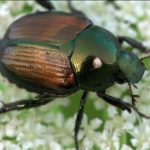
Japanese Beetle is an invasive insect pest that feeds on over 300 different plants. It emerges from a grub stage in the ground in late June, peaks around mid July and continues until early September. There are no natural enemies for Japanese Beetle in the US, and no one seems to have a successful strategy for eliminating them. We recommend a cumulative approach, which when combined, can be helpful.
We have stopped selling the BeetleGone and GrubGone because they are so expensive and only partially control beetles in your yard, and beetles fly in from the neighbors and beyond. We also don’t recommend Milky Spore, because it seems to not be effective in Colorado. Nematodes can work, but must be applied at the right time and often require repeated applications.
Here are some methods we do suggest; we hear it is better to start early in the season before the beetles make attracting chemical trails:
1) Hand-collecting: Very laborious and effective. Hold a container of soapy water under the beetles and tap them in. You can also use a one gallon jug with 2” of soapy water with a 6” funnel inserted in the top. Hold underneath and tap in. This is often more effective, fewer get away. Morning and evening collection works best, because this is when the beetles are sluggish.
2) Wild West Method: Fill a quart spray bottle with water and a capful of Dr. Bronners soap. Turn the sprayer to a single stream and shoot them down. Supposedly faster, and does kill the beetles.
3) Spray the plants with Neem: Neem is a non-toxic herb with insecticidal and fungicidal properties. It acts as an antifeedant, meaning the beetles don’t like to eat it, and if they do, their eggs will not live to the adult stage. Follow the directions using warm water and spray in the cool of the day. It is an oil, so don’t apply too often or it can affect plant respiration.
4) Trapping: I know, I know, reputable sources claim traps attract more than they catch. But we have many reports and our own experience indicating that they reduce numbers with less labor than collecting. We learned our method from anEast Coast teacher: skip the plastic traps which are expensive, stink, are hard to clean and have to be thrown away every year. Get a 5 gallon bucket, stick the adhesive bait on the inside of the bucket, 2”-3” down from the upper lip, put 3” of soapy water in the bottom. The beetles will hit the side of the bucket and fall into the water. Use a sieve to scoop out the beetles once a week and replace the water as needed. Easy, doesn’t stink and you reuse the bucket. If it is a bad year, use a new second bait mid-season. An improvement we learned is to site the bucket on the west side of the property, because the beetles usually fly in on the wind from the west and will get to the trap before they get to your roses or grapes. Let us know if it works for you.
5) Garlic Barrier and Mosquito Barrier: Garlic is strong medicine and most insects don’t like it. The smell goes away soon, but not to insects. Spray in the morning or evening in the summer. It will also reduce aphids and spider mites.
6) Remove buds and flowers: When the beetle damage starts to get bad, remove the flowers and buds, keep at it. These flowers will be damaged anyway, and removing them with remove the main attraction and save the energy of the plant. Then when beetle numbers have decreased, stop removing the buds and you will have a glorious late season bloom
7) Plant spring blooming roses/flowers: Ones that are done blooming by mid June/early July (like Heirloom and species roses).
8) Remove plants that are magnets to the beetles: Virginia Creeper, Morden Sunrise Rose etc.
9) Rowcover Fabric: Cover after fruit has started to form on veggies and berries, cover with light pest-fabric. We carry ‘Seed Guard’ fabric.
10) Plant strongly aromatic plants like garlic, thyme, annual geraniums etc with your roses or plants that are being eaten
11) Don’t spray toxic chemicals: They will kill or weaken your beneficial insects, birds, pets, kids, you, or your soil life.
Grow Your Own Berries

Triple Crown Blackberry
Among the fruits we eat, berries are closer to wild foods and are therefore much higher in antioxidants and phytonutrients that strongly support our immune systems and general health. Berries are also kid-height and kids don’t need encouragement to pick them once they know when they are ripe!
Most berries are unavailable in grocery stores and are very seldom found at farmer’s markets. The few berries that can be found, blueberries, strawberries, raspberries and blackberries, are picked unripe, shipped hundreds or thousands of miles, and are most often lacking in the flavor and freshness of homegrown fruits. These days, many are even grown in greenhouses, or even hydroponically, where the fruits don’t receive the natural stimuli for producing phytonutrients.
Most berries are pretty easy to grow. Currants and gooseberries are moderate-sized shrubs, and grow best in partial shade in Colorado, with soil improved with one third compost to two thirds your regular clay soil. Water deeply twice a week the first year, and usually once a week deeply once the plants are mature. The fruits of our native currants (Ribes aureum and Ribes odoratum), particularly the selections ‘Crandall’ and ‘Gwen’s Buffalo’, are sweet and flavorful when fully ripe, and relished by children of all ages. European currants and gooseberries are favorites for making pies and preserves, with the addition of sugar.
Elderberries have been grown for their medicinal and culinary uses, as well as their beauty and rapid growth, for centuries. They grow to 8-10 feet tall and wide and need two different varieties of the same species for pollination (for example: plant one Sambucus nigra ‘Mikl’s’ and one S. nigra ‘Marge’ near one another to get fruit. They can even be planted together in one hole if you have a small space. Elderberries also thrive in part shade or morning sun and afternoon shade, and soil and watering recommendations are the same as for currants. In addition to elderberry syrup, you can
make elderberry brandy with the flowers or the berries, as well as elderberry flower pancakes, and all kinds of baked goods and preserves.
Raspberries are suckering plants that make colonies and can be planted in rows and staked to wires between free posts. Ours are either ever-bearing varieties, bearing in summer on old canes and again in fall on new canes, or Primocane varieties, bearing fruit on the current year’s canes in the fall. They have prickly stems, but the berries are easy to reach for harvest without injury. There is nothing like a fully ripe, fresh raspberry! Our varieties are ‘primocane’, meaning that they bear fruit on new (the current year’s) growth. We recommend mowing them down in autumn, even if the variety is “everbearing”. Part shade is ideal for raspberries, but full sun is okay, too. All are best fertilized with half to one cup of organic fertilizer every September, and mulched to make good crops.
Our varieties are ‘primocane’, meaning that they bear fruit on new (the current year’s) growth. We recommend mowing them down in autumn, even if the variety is “everbearing”. Part shade is ideal for raspberries. All are best fertilized with half to one cup of organic fertilizer every September, and mulched to make good crops.
Our Blackberries are thornless (and you wouldn’t want them any other way!). The canes can be tied to a trellis or fence, and soil and fertilizer recommendations are the same as those for raspberries.’ Triple Crown’ produces large, delicious berries that begin ripening in late July or early August on second-year canes. We have never found store-bought blackberries that were worth paying for.
Currently in stock:
‘Triple Crown’ Blackberry – This productive plant yields large, juicy, black berries that offers copious crops on vigorous canes. Named for its three attributes: flavor, productivity, and vigor. Thornless semi-erect canes need support, especially under heavy fruit load. Self pollinating and disease resistant. Ripens begins in late July/early August. Hands-down winner of a public taste-test conducted by Boulder County extension service at Longmont Farmer’s Market. Hardy to USDA zone 5.
‘Pixwell Gooseberry’ – Prolific large oval berries that are light green, turning rosy pink when ripe. Fruit is prized for pies and preserves, more than for fresh eating. Best in part shade if summers are hot. Mildew and drought resistant. Hardy to USDA zone 3.
‘Hinnomaki’ Red Gooseberry – A medium-sized red gooseberry with outstanding flavor. The skin is tangy and the flesh is sweet. Great for fresh eating or pies. This very productive, upright bush has good resistance to mildew. Hardy to zone 2. Does well in sun to part shade.
Cutleaf Black Elderberry – Sambucus nigra v laciniata- A fast growing deciduous shrub known for its fern-like green foliage and white, citrus-scented flowers. It offers high wildlife value, providing edible black berries in late summer. It thrives in full sun to part shade. Plant with another S. nigra variety for successful fruiting. Makes great elderberry syrup. Hardy to USDA zone 3.
‘Marge’ Black Elderberry – Sambucus nigra- A cross of the American black elderberry with the European black elderberry which gives us large berries and all of the characteristics of the European varieties. ‘Marge’ is said to be self-pollinating so only one plant is needed for fruit production. Flowers form on the previous year’s woody growth so fruit will begin to form the second year after planting. Very productive. Hardy to USDA zone 3.
‘Mikl’s’ Black Elderberry – Sambucus nigra – Highly regarded as a medicinal plant for immune system support, Mikl’s has large showy clusters of white flowers followed by clusters of small, purple-black berries that can be used for jams and jellies or in tinctures and syrups. Plant another black elderberry for pollination. This one comes from a plant in Mikl’s garden. Hardy in Boulder the last 35 years.
‘Johns’ Elderberry – Sambucus canadensis – Produces more fruit and earlier than other elderberries. Very large clusters of medium sized berries which are especially good for pies, jellies and elixirs. Needs a pollenizer, any other sambucus canadensis selection. Hardy to USDA zone 3.
‘Imperial White’ Currant – Ribes sativum – Pearly white translucent fruit has a pink blush with a flavor that is milder and sweeter than its red counterparts. Delicious fresh or for jams and jellies. Vigorous and hardy to USDA zone 3.
‘Heritage’ Red Raspberry – Rubus idaeus – Fall-fruiting heirloom. A tough and easy variety that is productive and good flavored. Mow to the ground in late Fall or February-mid March and remove all debris. Bushy habit requires no staking. Hardy to USDA zone 4.
‘Anne’ Raspberry – Rubus idaeus – Tested in Colorado. Produces large, super sweet berries, and considered the best tasting among the yellow varieties. Canes are long and vigorous. Mow to the ground in late fall or February – mid-March and remove the debris. Ripens from August to frost.
Black-fruiting Nanking Cherry – Prunus tomentosa ‘Nigra’ – A beautiful shrub that has both ornamental and edible qualities. The deep purple fruits have a sweet taste and a juicy texture. Plant with another Nanking Cherry selection for successful fruiting. Hardy to USDA zone 3.
Mouthwatering STRAWBERRIES on Sale THIS WEEK for 20% off!
 When you buy fresh strawberries at the grocery store, are they ripe? No. Delicious? No. Expensive? Yes. Enough said.
Earliglow: Many people miss out on the best-tasting strawberries because they are “June bearing.” Why buy ‘Earliglow’ Strawberry when it only fruits in June? Because the flavor is fabulous and because it produces a lot all through the month, so even a small patch can produce enough berries for bowls or strawberry shortcakes you will remember. A bigger patch yields enough for preserves, too. “Earliglow is prized for its rich, classic heirloom sweetness, glossy red skin and firm texture. Highly vigorous and cold-hardy, this variety is exceptionally beginner-friendly and renowned for producing abundant runners (more plants). It is perfect for fresh eating, freezing and jams. It is also disease resistant.
Ogallala: A vigorous, very cold-hardy, ‘everbearing’ strawberry that “combines the sweet, intense flavor of the Rocky Mt. wild strawberry with the large size of traditional garden varieties.” (McKay Nursery) It was bred at the Cheyenne Horticultural Station to withstand drought, zone 3 cold, heat and exposure. It has a long season and is high yielding. A small patch can provide delicious grazing, offering a few ripe fruits just about
every day from June to September.
For a limited time, these two strawberry varieties are available at 20% off the regular price. ENJOY!
Top Fragrant Roses In Stock

Zepherine Droulin
Yes, I know. Here we are, talking about roses and about how to control the Japanese beetles that love them, in the same newsletter. Well, fragrant heirloom roses are worth it! And we currently have stock of some of the most sought-after varieties. Cases in point include Zephirine Drouhin, an heirloom climbing Bourbon rose with completely thornless canes and elegantly scrolled, very fragrant medium pink blossoms that repeat-bloom. Zephirine is perfect for growing on an arched entry trellis, especially where she gets afternoon shade, topping out at 6 to 7 feet tall.
Then there’s heirloom Rose de Rescht, purportedly from Ispahan, Iran, and known as one of the very most fragrant roses

Rose de Rescht
ever. The bush blooms first on old wood, then again on new canes. The 2-3” flowers are packed with deep magenta-purple petals and unforgettable fragrance. She grows in a compact shrubby form, without any floppy, arching branches, to anywhere from 3 to 5 feet tall and wide.
Of course we stock many great roses, many of which are fragrant, all grown on their own roots.
Clematis fruticosa – ‘Mongolian Gold’
 Looking for a compact shrub that blooms all through July? And August, and into September? ‘Mongolian Gold’ Clematis
 may be your answer. Eve’s has graced her front yard for about 30 years, and reliably makes a mound about 2 feet high and 3 feet wide every year. Most people assume that all Clematis are vines, but this is an exception. Mongolian Gold begins blooming in early July and just keeps going and going. Honeybees and native bees visit the lightly fragrant pendant yellow flowers often. In Eve’s garden, Mongolian Gold Clematis is located under the southeast edge of the canopy of a very large Douglas Fir tree that’s been limbed up, so it receives full sun in winter, and in the morning from spring through fall. It is watered only occasionally. It has a somewhat weeping habit and makes a perfect accent shrub where its branches can cascade over a short wall. The plant makes a permanent woody base framework that, once mature, should be pruned yearly in February to shorten the previous year’s slender stems. We’ve never seen any pest damage on Mongolian Gold.
Just in: Two Rare Native Shrubs
We just got in two plants we have had many requests for: come soon, supplies are limited.

Boulder Raspberry
Boulder Raspberry, Rubus deliciosus: This lovely local native shrub is adorned with large single white blossoms that look similar to wild roses, blooming in May and June. Pollinators that are attracted to Boulder Raspberry are: Bumblebees, native solitary bees like metallic green sweat bees, mason bees and mining bees, also honey bees, lady bugs, butterflies and beneficial syrphid flies. It grows 3-5’ high and wide with arching stems. Although it is named Rubus deliciosus, it is neither a thorny raspberry, nor are the fruits delicious. But it is a beautiful shrub for the home landscape. It grows best in partial shade with water once a week.

Leadplant
Amorpha canescens, Silver Leadplant – This Colorado native plant fits into small water-wise landscapes, growing only 2’-4’ tall and wide. In June/July it blooms with showy spikes of purple flowers which are rich in both nectar and pollen. Pollinators include Bumblebees, metallic green sweat bees, plasterer bees, leaf-cutter bees, butterflies, beneficial wasps and is a host plant for butterflies. The small compound leaves add a lovely texture, and the plant is nitrogen-fixing.
Mycorrhizae bring water and vitality to plants

root system with myccorhizae
Mycorrhizae are fungi that form mutually beneficial relationships with plants. Over 90% of all plants on Earth form these relationships with plant roots: plants share the food sugars they produce through photosynthesis, and mycorrhizae, with their extensive mycelial network, bring water and nutrients to the plants. This relationship is often essential to the survival of plants growing in harsh conditions or through climate extremes. [Read More]
Perfect Time to Plant Tomatoes, Peppers, Eggplants, and Annuals in Containers!

Tidy Treats tomato
Now that hot weather is here to stay for a while, we can plant outdoor containers for our balconies, porches and patios without having to worry about cold nights. We have plenty of great varieties to choose from, and superior potting soils like Ocean Forest and Coco Loco. At last count, we had just a few large decorative ceramic pots left.[Read More]
Now Featuring our Best Selection of Sustainable Roses!
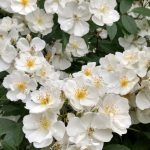
Darlow’s Enigma
Though I’ve often talked to you about native and water-wise plants, I am still referred to as ‘the Rose Lady’ at
Harlequin’s. I still love roses, and still grow some choice favorites for their fragrance, beauty and ease. Some of them, Banshee and Desiree Parmentier, have been in my garden for 34 years – far longer than I have. [Read More]
Blue Blazes is here! Pollinators & Gardeners Rejoice!
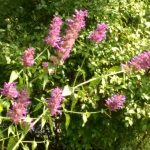
Blue blazes
One of our favorite hardy Hummingbird Mint varieties, ‘Blue Blazes’, is ready now in 1-gallon pots, perfect for summer planting. For many years, the gorgeous specimen in Eve’s water-wise front yard elicited admiration, comments and questions from passing pedestrians, cyclists and motorists. Many asked ”What is that shrub with the glowing purple-magenta flower spikes?”
This vigorous, showy, large (40-50” tall x 24-30”w) native hybrid blooms non-stop from mid-June to fall, providing a tremendous pollen and nectar source for hummingbirds, butterflies, and bees. The fragrant foliage resists deer and rabbits. Plant in well-drained, low-fertility soil, in full sun. Hardy in Zones 5 to 9. ’Blue Blazes’ was bred by our friend and Colorado horticultural star, Kelly Grummons. Eve’s trees eventually shaded out her ‘Blue Blazes’.
Also available now in #1 pots: Agastache ‘Poquito Butter Yellow’, a newer dwarf, bushy hummingbird mint (10 – 13”h x 15”w) for smaller gardens, ‘hell-strip’ plantings, containers or mass plantings. Its fresh, buttery color is new to Agastache, and the large flowers keep coming
from mid-June to hard frost. Dead-head spent blooms in summer, but leave some spikes standing for the Goldfinches and other songbirds that love the seeds. Plant in full sun in low-fertility, well-drained soil (not heavy clay). ‘Poquito Butter Yellow’attracts butterflies, hummingbirds and native bees, and is resistant to deer and rabbits. Hardy in zones 5 to 10.
Plants for Shade – Hosta and more!

Dicentra
As much as we are looking forward to summer heat and sun, we will be equally grateful for a bit of cool, shady respite. Many of us living in older neighborhoods enjoy mature trees that provide quite a bit of shade. These present a challenge: what plants will thrive beneath them and in their shadow? Right now, Harlequin’s has our biggest selection of plants for dry shade, moist shade, and moderate shade.[Read More]
Explore New Dimensions with Vines

Lonicera x brownii ‘Dropmore Scarlet’
Vines are plants that grow stems so long that they either ‘crawl’ along the ground or use a method of climbing using twining, tendrils, leaf-stems that wrap, hold-fasts, aerial rootlets, or hooked thorns. Many a wall, fence or planting patch cries out for the fabulous color, texture, shading, ground-covering, screening, bird habitat and fragrance opportunities offered by vines.
Native Shrubs for the Garden and Landscape

Mikl with Desert willow

Desert willow in bloom
Harlequin’s Gardens is famous for our selection of Native Shrubs. Not only do we have them when few other nurseries do, but we know them and we have mature specimens planted in our display gardens. These woody plants that are so well adapted to Colorado conditions are often drought tolerant, low maintenance, bee and pollinator-supporting, wind-tolerant, cold-tolerant and good-looking. Like many shrubs, some benefit from a once-a-year pruning to remove dead flowers before they make seeds. This will make them more tolerant to drought and snow and wind, but seeds can be left for the birds and pruned late fall.
Native shrubs can be grown together for a very water-wise and low maintenance garden that is tied together visually with a fine woodchip mulch.
Fernbush (Chamaebatiaria millifolium) is a beautiful Plant Select® shrub that is usually 4’- 6’ tall and wide with fern-like leaves that come out in mid January or February. It is very tolerant of dry conditions, heat and bright sun. In summer, clusters of small white flowers cover the bush densely and often bloom a little more in fall. These flowers are extremely attractive to beneficial insects, especially native, non-aggressive wasps which help keep down populations of pests and are intent on pollen, not people. This shrub is tough enough for the back 40 and attractive enough for the front yard. It can be sheared (or pruned) lightly after blooming for a tidier appearance and to encourage rebloom. Fernbush is native to Idaho, Utah and northern Arizona.
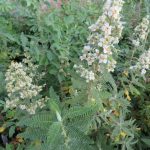
Fernbush
Chilopsis linearis is called Desert Willow because it has narrow, willow-like leaves and is very drought-tolerant. It is a small tree 6’-15’ with an open structure and does not leaf out until May, even late May. It is related to Catalpa tree and Trumpet Vine. The orchid-like flowers are so surprising and breath-taking; ruffled, trumpet-shaped, pink to red-purple, striped purple inside. Chilopsis prefers dry, loose soils, but clay is OK if it is seldom watered. At night it is visited by hawkmoths and is scented of violets according to Bob Nold. He also says it “…is the toughest shrub that can be grown in our garden…I have never watered my plants.” The flowers bloom for a long time and are followed by narrow pods that are not messy. Chilopsis is native to New Mexico, Nevada and Utah. Books often say it is hardy to zone 7, but we have specimens over 10 years old at Harlequin’s and Denver Botanic Gardens has many older trees. Often, the flowering tips die and look better pruned off.
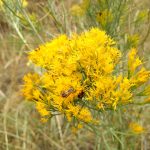
Dwarf blue rabbitbrush
Dwarf Rabbitbrush (Ericameria or Chrysothamnus) has been called The Gem of the Tribe. It is a compact shrub 1’-2’ high and 2’-3’ wide with short and narrow bluish leaves and clouds of golden yellow flowers in throughout autumn. The flowers are very attractive to pollinators; it is a crucial late-season food source, supplying nectar and pollen for native bees, honeybees, Monarch and other butterflies, moths and even hummingbirds. Once established, this shrub thrives with little or no watering. It also provides a welcome display of color in the late season and if it is sheared after flowering, will stay compact and attractive enough for the front yard. It is native near Harlequin’s in the open and dry high desert and steppe, and in much of Colorado.
Prune Now to Keep Woody Plants Smaller
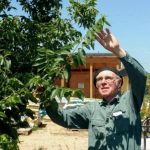 Do you have a tree or shrub that you’d like to restrain from getting much larger? For the next 3-4 weeks, pruning will be the most effect in reducing the size of woody plants. As we near the Summer Solstice, this year on June 21, we are approaching the midpoint in the growth cycle. This is the time when the days are longest and sunlight is strongest in the northern hemisphere. Woody plants start growing rapidly in early spring using energy that was stored in the roots and branches last fall. By mid-summer, the tree’s resources are being stored in the foliage to support photosynthesis.
So, when we prune at this time, we are removing these resources for growth. This is why summer pruning slows growth. By late summer and fall the nutrients are again being stored in the roots and branches, so pruning removes fewer growth-inducing resources. This is also the reason that fertilizing in late summer and fall is the best time to strengthen a tree or shrub, and support development of the buds that will become next year’s flowers and fruits. Note that solstice pruning of trees and shrubs that bloom in mid to late summer will remove the current year’s bloom and fruiting potential (Bluemist Spirea, Russian Sage, Golden Raintree, Rose of Sharon, Seven Son Flower, etc.)
Incidentally, If you would like to keep certain tall fall-blooming perennials more compact and stocky and less floppy or top-heavy, you can shear them back by a third to a half in late June/early July. This works well for tall asters and goldenrods, Blue Sage (Salvia azurea), Agastache.
More plants coming! Others selling out fast!

Hostas
First of all, we have MANY plants just becoming ready, MANY we had held back for lack of time and space. So just because we had a huge influx of perennials a couple of weeks ago doesn’t mean we’d brought them all out for sale. But here they come now! Also, we’re now bringing out flats and flats of perennials now that they’re fully rooted into their pots. And these all look glorious!
Many are specialty items, including great Native and Pollinator Favorites! At the same time, if you’re looking for Peonies, Hosta, Ferns, Bleeding Hearts, Lungworts (Pulmonaria), Variegated False Forget-me-not (Brunnera), Hellebores, Golden Wood Poppies (Stylophorum diphylum) and some other classic long-lived spring perennials, these sell out quickly and will not be re-stocked until next year, so come for them now!
A note of advice about plants in small pots or 6-packs: These may have come recently from greenhouse conditions, so be sure to water them frequently until you get them planted in the ground or in larger pots.
Penstemon palmeri – Palmer’s Beardtongue

Palmer’s Beardstongue
2-5’ tall x 1-2’wide, Full Sun
Hardy to 6500’
Deer-resistant
Stop the car! What’s that mass of pink soaring above the roadside slopes? The largest of the hardy Penstemons, both in plant size and flower size, Palmer’s is a magnificent plant with a commanding presence. Above the substantial and attractive serrated, fleshy gray, evergreen leaves, towering flower spikes from 2 to 5’ tall display large, wide-mouthed light pink flowers marked with darker veins, and exuding a sweet fragrance.
These are specifically adapted to accommodate larger pollinators, particularly bumblebees, carpenter bees and hummingbirds. Butterflies and moths also visit them. Native to dry washes, sandy plains, and canyon slopes of the Intermountain West and Southwest, including Colorado and Wyoming, Palmer’s Penstemon colonizes open, well-drained soils from desert foothills to about 6,500 feet elevation. Adaptation
to poor, gravelly soils and periodic drought makes it a perfect choice for xeriscape and low-water gardens. Widely adapted and requiring minimal care, it will thrive and naturalize from seed, and can form impressive colonies.
Feed your Vegetables so they can Feed You!

Age Old Bloom
This spring, you probably incorporated some organic fertilizer into the soil for your garden, particularly if you are growing vegetables or annual leafy herbs. For optimal yields, many of these plants will benefit from additional fertilizer applications through the summer. This can be done with side-dressings of granular fertilizers like Age Old ‘Grow’ (for foliar crops) or ‘Bloom’ (for fruiting crops). But for faster results, we recommend liquid organic fertilizers, because they can be quickly absorbed by plant roots and foliage. Tomatoes, peppers, eggplants, squashes, pumpkins, melons, and corn are considered either moderate or heavy feeders, and we recommend using either Age Old liquid ‘Bloom’ or Neptune’s ‘Rose & Vegetable’. This can be applied to the soil every two weeks or applied to all surfaces of the leaves for foliar feeding (apply to foliage in cloudy weather or just after sundown). Kale, Collard Greens, Broccoli, Cauliflower, and Cabbage are ‘brassicas’ that are considered heavy feeders, along with Bulbing Fennel, Swiss Chard and Basil. These foliage crops appreciate supplemental summer feeding to maintain their supply of nitrogen, which can be easily supplied every two weeks by Age Old liquid ‘Grow’ or Neptune’s Harvest Fish & Seaweed’.
Compost Tea Featuring Local TerraForma Compost Ready this Weekend!

Brewing Compost Tea
You can think of compost tea as vitamins for plants; they are a great overall plant health booster. In turn, healthy plants are better able to resist pests and diseases. Our customers have told us that our compost tea has very clearly strengthened and improved the growth of their plants. Benefits associated with compost tea include:
Improves soil health. If soil is nutrient-rich, the need for fertilizer is minimized.
Improves water retention. This reduces the need for frequent watering.
Improves soil structure. The biological components in a soil are what create its structure. For
good soil structure, all organism groups in the food web – bacteria, fungi, protozoa, nematodes
and micro arthropods – need to be present. By using compost tea you are adding this large
spectrum of beneficial microbes.
Stimulates plant root growth. Deeper roots retain moisture better and help reduce runoff.
Spiders in Your Neighborhood
 Spiders in Your Neighborhood: A Field Guide to Your Local Spider Friends A fun, friendly, all-ages field guide to common Western spiders
Spiders! Scary? Maybe. Cool? Definitely. Author Pat Stadille used to be terribly afraid of these eight-legged daddies, until he started learning more about them. Now spiders are his best friends! Once you hear about their silky skills, hunting habits, and generally shy and gentle nature, you might feel the same way. Learn about jumpers, wolf spiders, tarantulas, the “bird turd spider,” and, of course, the black widow!
Rocky Mountain Native Plant Primer
 The Rocky Mountain Native Plant Primer: 225 Plants for an Earth-Friendly Garden
by Lauren Springer and Bryan Fischer
The great Colorado gardening book we’ve been waiting years for is HERE AT LAST! Over the years, Colorado’s best and brightest garden writers, including Lauren Springer, have produced excellent books to help gardeners understand and work with the weather, soils, plants, pests and peculiarities of gardening here in the Rocky Mountain region. But before long, they were all out of print! With so many new gardeners, ‘new-to-Colorado’ gardeners and ‘new-to-natives’ gardeners needing expert advice for gardening HERE, in our various situations, from the urban-suburban metro area, to the plains, foothills, steppe and mountains, the lack of good resources in print was a big problem.
Fortunately, Lauren Springer returns, partnering with colleague Bryan Fischer, with an essential resource for gardening successfully and beautifully with native plants to attract and support pollinators and beneficial wildlife, and reduce maintenance at the same time! The wonderful photographs, the organization and presentation of accurate, practical growing information, and the solid decades of experience behind this book make it a treasured resource you will refer to for a lifetime. And remember – Harlequin’s Gardens members get 25% off books all year long!
New Perennials, Vines, and Annuals!
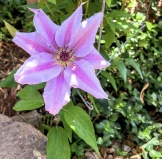 This Weekend! New Perennials, Vines, and Annuals
Here’s a glimpse of some of the influx of plants we expect to have ready for you by this weekend! Some are rare finds in limited quantities, so try not to miss out! .
Agastache cana – Double Bubble Hummingbird Mint
Artemisia frigida – Fringed Sage
Asclepias incarnata – Rose Milkweed
Dalea purpurea – Purple Prairie Clover
Engelmannia peristenia – Engelmann’s Daisy
Iris missouriensis – Native Wild Iris
Liatris pychnostachya – Prairie Blazing Star
Nepeta x faassenii -‘Walker’s Low’ Catmint
Tradescantia occidentalis – Western Spiderwort
Dahlia – Bishop’s Children
Dahlia – Short Mix
Nasturtium – Alaska Mix
Nasturtium – Jewel
Nasturtium – Ladybird
Nasturtium – Peach Melba
Nasturtium – Tall Mix
Nasturtium – Tiptop
Pansy – Velvet Mix
Poppy – Lauren’s Grape
Poppy – Mission Bells
Poppy – California Orange
AND MORE!
Cool-Season Vegetable Starts expected 3/26/26
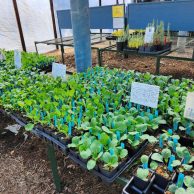
Cold-Season Vegetable Starts – March
We’re very excited this week to debut spring vegetable starts that MASA has grown for us! These bioregionally-adapted varieties are so robust and full of vitality, and so irresistible! They are also selected for resilience in our wide weather swings. If you can water your garden, these plants will give you a bountiful head-start on home-grown, delicious, nutritious, greens! We’ll be bringing in more each week.
Arugula Astro
Broccoli Nutribud
Broccoli Umpqua
Cabbage, red Amarant
Cabbage, green Tendersweet
Cabbage, green Tiara
Chard Bali Red
Chard Bright Lights
Chard Fordhook
Collards, Flash
Kale, curly purple Redbor
Kale, lacinato Black Magic
Kale, curly DarkiborCo
Lettuce, butter Adriana
Lettuce, Romaine Forellenschluss
Lettuce, dwf Rom. Spretnak
Lettuce, red leaf Hyper Red Rumpled
Lettuce, green leaf Winter Density
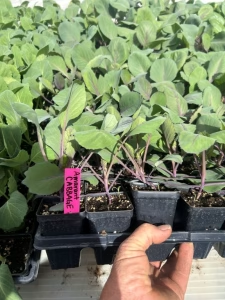
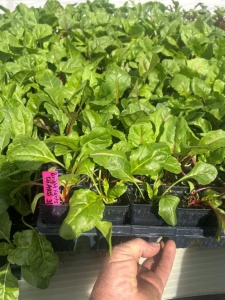
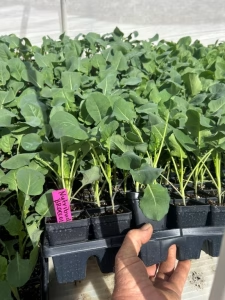
Shrubs and Grasses this Weekend!
Tufted hairgrass
Trees:
Amelanchier alnifolia (native)
Shrubs:
Amelanchier alnifolia ‘Regent’ (native)
Peraphyllum microphyllum (native)
Prunus besseyi ‘Pawnee Buttes’ (native)
Prunus besseyi ‘Flatiron’ (native)
Syringa vulgaris – Common Lilac
Viburnum x ‘Sarcoxie’
Cotinus coggygria ‘Winecraft Black’ – Purple Smokebush
Raspberries:
Heritage and Polana red raspberries
Grasses:
Deschampsia caespitosa – Tufted Hairgrass (native)
Panicum virgatum ‘Shenandoah’ – Red Switchgrass
Schizachyrium scoparium ‘Prairie Blues’ – (native)
Perennials:
Sedum ‘Purple Emperor’
groundcover – Ephedra minima