• Skip to primary navigation
  • Skip to main content
  • Skip to primary sidebar
  • Skip to footer
Harlequins Gardens

Harlequins Gardens

Boulder's specialist in well-adapted plants

We’re currently open Tues-Sun, 9-5

Memberships & Gift Certificates – available online
See our seasonal hours and address below • Read our latest e-newsletter!

Help Support Our Mission: GoFundMe

  • Home
  • About
    • About Us
    • Staff
    • Display Gardens
    • Why the Name “Harlequin’s” Gardens?
    • Support Our Mission
    • Sustainability
    • Policy on Pesticides Including Neonicotinoids
    • Careers
  • What We Offer
    • Products
    • Plants
    • Gift Certificates
    • Membership
  • Plants
    • Annuals
    • Bulbs
    • Fruits
    • Groundcovers
    • Herbs
    • Natives
    • Ornamental Grasses
    • Perennials
      • Plants for Pollinators List
    • Roses
    • Vegetables
      • Tomato Starts
      • Pepper Starts
      • Other Vegetable Starts
      • Fall Vegetable Starts
      • Garlic
    • Xeriscape
  • Resources
    • Recommended Gardeners & Landscapers
    • Mikl’s Articles
    • Plant and Cultivation Information
    • Newsletters
    • Links
  • Garden Tours
  • Events
  • Classes
  • Blog
  • Wholesale
    • Wholesale Sales
    • Who Qualifies
    • Wholesale Pricing & Sizes
    • Wholesale Terms and Conditions
  • Contact
Home | Plants | Natives

Natives

Dealing with Change in the Garden

July 21, 2026

Shade in Eve’s garden

“The best laid plans of mice and men can still go awry” comes from a 1786 poem entitled “To a Mouse” by Robert Burns. It tells of how he, while ploughing a field, unwittingly upturned a mouse’s nest. The expression was then popularized by the 1937 novel, Of Mice and Men, by John Steinbeck.

[Read More]

Escape to the Tundra

July 14, 2026

King’s Crown – Rhodiola integrifolia

In early July, Mikl and I always take some time off to celebrate our wedding anniversary, and to escape the Front Range heat. This year, we decided on a stay-cation, with day-trip forays into the high alpine tundra, so easy for us to access from here. Just as spring came early down here at a mere mile above sea level, so it did up in the mountains. In past years, our early July trips to the alpine zone brought us to snowfields in mid-melt, revealing the very first blooms of the tundra –  mostly with their feet in the water. [Read More]

How to Plant in July

June 30, 2026

How To Plant in July And Keep Your Gardens Alive!

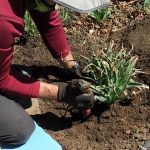
1) Before planting , prepare the soil by adding 2″ of compost and dig it into the to top 6″-8″ of soil OR Add 1″-2″ of expanded shale with the compost, then dig it in. This will open clay soil, increasing both porosity (aeration) and water holding capacity. Set the prepared soil aside.

[Read More]

Harlequin’s Gardens Pollinator Garden

June 23, 2026

We are in the last week of Pollinator Month. We still have a lot of good pollinator perennials and shrubs. Our pollinator garden is looking beautiful and many plants have labels. This garden was given a boost last spring by a grant from People and Pollinators Action Network, plus a lot of Harlequin’s plants. Last Saturday Mikl led a tour of the garden for the Garden Conservancy a national nonprofit working to share and celebrate America’s gardens.

[Read More]

Water-Wise Plants for a No-Water Garden

August 18, 2026

In our 35 years of experience gardening on our two-acre property in the rocky short-grass prairie in far-north Boulder, CO, we have found the plants listed here to grow successfully without supplemental watering once established. The early years of the gardens were blessed with more natural precipitation than we are experiencing now. Some plantings receive more attention than others, but these plants have all managed without irrigation for long stretches of time.

Acer negundo Boxelder Maple
Agave parryi Parry’s Agave
Allium tuberosum Garlic Chives
Argemone polyanthemos Prickly Poppy
Artemisia filifolia Sand Sage
Artemisia frigida Fringed Sage
Artemisia ludoviciana Silver King Artemisia
Artemisia tridentata Big Sage
Buddleia alternifolia argentea Silver Butterfly Bush
Celtis occidentalis Western Hackberry
Celtis reticulata Netleaf Hackberry
Cercocarpus intricatus Littleleaf Mt. Mahogany
Cercocarpus ledifolius Curlleaf Mt. Mahogany
Cercocarpus montanus Trueleaf Mt. Mahogany
Chamaebatiaria millefolium Fernbush
Cleomella serrulata Rocky Mt. Bee Plant
Cotinus ‘Grace’ ‘Grace’ Smoketree
Cotoneaster lucidus Hedge Cotoneaster
Cotoneaster racemiflorus var. soongoricus – Redbead Cotoneaster
Crataegus ambigua Russian Hawthorn
Crataegus phaenopyrum Washington Hawthorn
Cupressus arizonica Arizona Cypress
Ericameria nauseosa Tall Blue, Tall Green and Dwarf Blue

Fallopia aubertii Silver Lace Vine
Foeniculum vulgare Purpureum Bronze Fennel
Forestiera neomexicana Desert Olive
Glaucium acutidentatum Horned Poppy
Gleditsia triacanthos Honeylocust
Helianthus annuus Common Sunflower
Helianthus salicifolius Willow Leafed Sunflower
Iris germanica Bearded Iris
Juniperus monosperma One Seed Juniper
Juniprus scopulorum Rocky Mt. Juniper
Koelreuteria paniculata Golden Rain Tree
Limonium gmelinii Siberian Statice
Linum lewisii Native Blue Flax
Mahonia aquifolium Oregon Grape Holly
Mahonia fremontii Desert Holly
Malus other apples
Malus Royalty Royalty Crab
Marrubium cyllenaum Greek Horehound
Marrubium rotundifolium Silver Edged Horehound
Morus tatarica Hardy Mulberry
Penstemon Many species
Philadelphus coronarius Sweet Mock Orange
Pinus edulis Pinyon Pine
Pinus ponderosa Ponderosa Pine
Prunus americana American Plum
Prunus virginiana Canada Red Chokecherry
Prunus virginiana Chokecherry
Rhus glabra cismontane
Rhus trilobata Threeleaf Sumac
Rocky Mt. Sumac
Rosa eglanteria Sweetbrier Rose
Rosa Fruhlingsgold Spring Gold Rose
Rosa Henry Kelsey Henry Kelsey Rose
Rosa John Davis John Davis Rose
Rosa moyesii Eddy’s Jewel Rose

Sedum many varieties
Sphaeralcea fendleri Tall Globemallow
Syringa vulgaris Common Purple Lilac
Tanacetum parthenium Feverfew
Yucca baccata Banana Yucca
Yucca glauca Plains Yucca

Native Plants in Display Gardens for 5-7 Waterings Per Year

August 18, 2026

The native plants listed here have all been grown successfully in gardens here that were watered only 5 to 7 times per year. We amend our rocky soils when planting. Gardens vary in amounts and timing of sun exposure. Our definition of ‘native’ is broad, and includes plants from our specific locale, the state of Colorado, and the arid, temperate steppe, foothill, montane and alpine regions of the Rocky Mountain states and the southwest.

Achillea lanulosa (Achillea millefolium var. lanulosa) (Yarrow)
Agave parryi neomexicana (New Mexico Century Plant)
Amelanchier alnifolia (Serviceberry)
Amorpha canescens (Leadplant)
Amorpha fruticosa (False Indigo)
Amorpha nana (Dwarf Leadplant)
Amsonia jonesii (Jones’ Bluestar)
Andropogon gerardii ‘Pawnee’ (Pawnee Big Bluestem)
Andropogon saccharoides (Silver Beard Grass)
Aquilegia barnebyi (Barneby’s Columbine)
Aquilegia caerulea (Rocky Mt. Columbine)
Aquilegia chrysantha (Yellow Columbine)
Arenaria hookeri (Sandwort)
Argemone polyanthemos (Prickly Poppy)
Artemisia campestris (Wild Tarragon)
Artemisia filifolia (Sand Sage)
Artemisia frigida (Fringed Sage, Silver Sage )
Artemisia ludoviciana (Silver King Artemisia)
Artemisia nova (Black Sage)
Artemisia tridentata syn. Seriphidium tridentatum (Western Big Sage)
Artemisia tripartita(Cutleaf Big Sage)
Aster ericoides (Wreath Aster)
Aster fendleri ‘My Antonia’ (‘My Antonia’ Rock Aster)
Aster obligifolius (Aromatic Aster)
Aster sericeus (Silky Aster)
Atriplex canescens (Four-wing Saltbrush)
Atriplex confertifolia (Spring Saltbrush)
Baptisia australis minor (Dwarf False Blue Indigo)
Blepharoneuron tricholepis (Pine Dropseed)
Bouteloua curtipendula (Side Oats Grama)
Bouteloua gracilis (Blue Gramma)
Callirhoe involucrata (Wine Cups)
Calylophus serrulatus (Sundrops)
Ceanothus fendleri (Buckbrush)
Cerastium arvense (Field Mouse Ear)
Ceratoides lanata (Winterfat)
Cercocarpus intricatus (Dwarf Mountain Mahogany)
Cercocarpus ledifolius (Curl-leaf Mountain Mahogany)

Cercocarpus montana (Mountain Mahogany)
Chamaebataria millefolium (Fernbush)
Chilopsis linearis (Desert Willow)
Chrysothamnus nauseosus nauseosus (Dwarf Rabbitbrush)
Clematis ligusticifolia (Western Virgin’s Bower)
Coryphantha missouriensis
Crataegus douglasii (Douglas Hawthorn)
Cupressus arizonica (Arizona Cypress)
Cylindropuntia imbricata (Cholla, Candelabra Cactus)
Cylindropuntia whipplei (Whipple’s Cholla)
Datura wrightii (D. meteloides) (Sacred Datura)
Echinacea tennesseensis (Tennessee Coneflower)
Echinocereus caespitosus
Echinocereus reichenbachii (Lace Cactus)
Echinocereus triglochidiatus (Claret Cup Cactus)
Echinocereus viridiflorus
Eragrostis trichodes (Sand Love Grass)
Erigeron flagellaris (Whiplash Daisy)
Eriogonum heracleifolium
Eriogonum jamesii flavescens
Eriogonum niveum niveum
Eriogonum ovalifolium
Eriogonum umbellatum (Sulphur Flower)
Eriogonum umbellatum ‘Kannah Creek’
Eriogonum umbellatum subalpinum
Eriogonum wrightii wrightii (Wright’s Sulfur Flower)
Escobari vivapara
Fallugia paradoxa (Apache Plume)
Fendlera rupicola (Cliff Fendler Bush)
Forestiera neo-mexicana (New Mexican Privet)
Gaillardia aristata (Indian Blanket Flower)
Geranium fremontii (Fremont Geranium)
Geranium richardsonii (Richardson Geranium)
Gilia aggregata (Scarlet Gilia)
Gutierrezia sarothrae (Snake Weed)
Helianthus pumilus (Dwarf Sunflower)
Hesperaloe parviflora (Texas Red Yucca)
Humulus lupulus neomexicana (Wild Hop Vine)
Hymenoxys scaposa (Perky Sue)
Juniperus monosperma (Single-seed Juniper)
Juniperus scopulorum (Rocky Mt. Juniper)
Leucocrinum montanum (Sand Lily)
Liatris punctata (Gayfeather, Blazing Star)
Linum lewisii (Native Blue Flax)
Lithospermum multiflorum (Many-flowered Pucoon)
Lomatium orientale (Native Parsley)

Mahonia fremontii (Fremont’s Mahonia)
Mentzelia decapetala (Blazing Star)
Mirabilis multiflora (Desert Four-O’Clock)
Nolina microcarpa (Beargrass)
Oenothera caespitosa (Tufted Evening Primrose)
Oenothera howardii (Howard’s Evening Primrose)
Oenothera mac. Incana ‘Silver Blade’
Opuntia fragilis (Fragile Prickly Pear)
Opuntia polyacantha (Yellow Prickly Pear)
Oryzopsis hymenoides (Indian Rice Grass)
Oxytropis lambertii (Lambert’s Locoweed)
Panicum virgatum ‘Shenandoah’ (Red Switchgrass)
Pediocactus simpsonii (Mt. Ball Cactus)
Penstemon alamosensis
Penstemon ambiguous
Penstemon angustifolius
Penstemon arenicola
Penstemon barbatus ‘Coccineus’
Penstemon buckleyi
Penstemon cardinalis
Penstemon clutei
Penstemon cyananthus
Penstemon davidsonii
Penstemon gormanii gormanii
Penstemon grandiflorus
Penstemon havardii
Penstemon linarioides coloradoensis
Penstemon mensarum
Penstemon palmeri
Penstemon procerus
Penstemon pseudospectabilis
Penstemon rostriflorus (Bridges Penstemon)
Penstemon secundiflorus (Sidebells Penstemon)
Penstemon strictus (Rocky Mt. Penstemon)
Penstemon teucroides
Penstemon virens
Penstemon virgatus ssp. asa grayii
Pinus edulis (Pinyon Pine)
Pinus ponderosa (Ponderosa Pine)
Populus tremuloides (Quaking Aspen)
Prunus americanus (Wild Plum)
Prunus besseyi (Western Sand Cherry)
Prunus besseyi ‘Pawnee Buttes’ (Dwarf Sandcherry)
Prunus virginiana (Chokecherry)
Ptelea trifoliata (Wafer Ash, Hop Tree)
Quercus gambelii (Gambel Oak)

Quercus undulata (Wavy Leaf Oak)
Rhus trilobata (Lemonade Bush, Skunkbrush)
Ribes aureum (Golden Currant)
Ribes cereum (Wax Currant)
Ribes odoratum ‘Crandall’ (Crandall Clove Currant)
Rosa acicularis (Arctic Rose)
Rosa arkansana
Rosa woodsii (Woods Rose)
Schizachyrium scoparium ‘The Blues’ (Little Bluestem)
Sedum lanceolatum (Lanceleaf Stonecrop)
Senecio spartioides (Grassleaf Senecio)
Shepherdia argentea (Silver Buffaloberry)
Silene regia (Royal Catchfly)
Solidago nana (Dwarf Goldenrod)
Sorghastrum nutans (Indian Grass)
Sphaeralcea coccinea (Cowboy’s Delight; Scarlet Globemallow)
Sphaeralcea incana (Globe Mallow)
Sporobolus airoides (Alkali sacaton)
Sporobolus heterolepis (Prairie Dropseed)
Sporobolus wrightii (Wright’s Sacaton)
Tradescantia occidentalis (Western Spiderwort)
Yucca baccata (Banana Yucca)
Yucca glauca (Narrowleaf Soapweed)
Yucca harrimanii (Dollhouse Yucca)

Amorpha fruticosa – False Indigo  A Versatile Native Shrub

August 25, 2026

Amorpha fruticosa – False Indigo  A Versatile Native Shrub

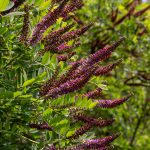
Leadplant has a little brother, Amorpha nana, but did you know that it also has a big sister? Like its kin, False Indigo is deciduous, and is a legume with deep branching roots that fix nitrogen from the air, enriching the fertility of the soil around it. You’ll find it growing in areas with relatively high water-tables or periodic flooding, such as Walden Ponds in east Boulder County.

Grown in full sun, it makes a densely twiggy and fine-textured shrub to about 4’ tall and wide, and grown under tall trees or in places shaded by high walls, it will be graceful, open and airy, and taller – up to 12’x 8’. Slender, smooth stems are gray, and the pinnately compound foliage is fine-textured, with dark green ½”-long oval leaflets that turn bright gold in autumn. The showy blooms arrive in late May or June, arranged in finger-like tapering spikes of tiny dark blue-purple florets with conspicuous orange stamens. These are visited by butterflies for their nectar, and bees as well, for pollen and nectar. Small bean pods ripen in late summer and autumn, and are enjoyed by many birds. False Indigo is cold-hardy to -30F, fast-growing and long-lived. It’s not fussy about soil, and tolerates high heat as long as it is receiving some moisture. Once it has built a good root system, False Indigo should thrive with two deep waterings per month. A lovely companion to Silver Buffaloberry, Golden Currant, Rocky Mountain Maple, Chokeberry, and New Mexico Privet.

Plants for Shade – Hosta and more!

May 19, 2026

Dicentra

As much as we are looking forward to summer heat and sun, we will be equally grateful for a bit of cool, shady respite. Many of us living in older neighborhoods enjoy mature trees that provide quite a bit of shade. These present a challenge: what plants will thrive beneath them and in their shadow? Right now, Harlequin’s has our biggest selection of plants for dry shade, moist shade, and moderate shade.[Read More]

Native Shrubs for the Garden and Landscape

May 19, 2026

Mikl with Desert willow

Desert willow in bloom

Harlequin’s Gardens is famous for our selection of Native Shrubs. Not only do we have them when few other nurseries do, but we know them and we have mature specimens planted in our display gardens. These woody plants that are so well adapted to Colorado conditions are often drought tolerant, low maintenance, bee and pollinator-supporting, wind-tolerant, cold-tolerant and good-looking. Like many shrubs, some benefit from a once-a-year pruning to remove dead flowers before they make seeds. This will make them more tolerant to drought and snow and wind, but seeds can be left for the birds and pruned late fall.

Native shrubs can be grown together for a very water-wise and low maintenance garden that is tied together visually with a fine woodchip mulch.

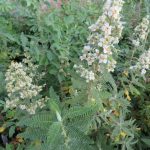
Fernbush (Chamaebatiaria millifolium) is a beautiful Plant Select® shrub that is usually 4’- 6’ tall and wide with fern-like leaves that come out in mid January or February. It is very tolerant of dry conditions, heat and bright sun. In summer, clusters of small white flowers cover the bush densely and often bloom a little more in fall. These flowers are extremely attractive to beneficial insects, especially native, non-aggressive wasps which help keep down populations of pests and are intent on pollen, not people. This shrub is tough enough for the back 40 and attractive enough for the front yard. It can be sheared (or pruned) lightly after blooming for a tidier appearance and to encourage rebloom. Fernbush is native to Idaho, Utah and northern Arizona.

Fernbush

Chilopsis linearis is called Desert Willow because it has narrow, willow-like leaves and is very drought-tolerant. It is a small tree 6’-15’ with an open structure and does not leaf out until May, even late May. It is related to Catalpa tree and Trumpet Vine. The orchid-like flowers are so surprising and breath-taking; ruffled, trumpet-shaped, pink to red-purple, striped purple inside. Chilopsis prefers dry, loose soils, but clay is OK if it is seldom watered. At night it is visited by hawkmoths and is scented of violets according to Bob Nold. He also says it “…is the toughest shrub that can be grown in our garden…I have never watered my plants.” The flowers bloom for a long time and are followed by narrow pods that are not messy. Chilopsis is native to New Mexico, Nevada and Utah. Books often say it is hardy to zone 7, but we have specimens over 10 years old at Harlequin’s and Denver Botanic Gardens has many older trees. Often, the flowering tips die and look better pruned off.

Dwarf blue rabbitbrush

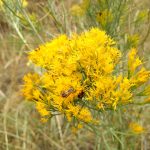
Dwarf Rabbitbrush (Ericameria or Chrysothamnus) has been called The Gem of the Tribe. It is a compact shrub 1’-2’ high and 2’-3’ wide with short and narrow bluish leaves and clouds of golden yellow flowers in throughout autumn. The flowers are very attractive to pollinators; it is a crucial late-season food source, supplying nectar and pollen for native bees, honeybees, Monarch and other butterflies, moths and even hummingbirds. Once established, this shrub thrives with little or no watering. It also provides a welcome display of color in the late season and if it is sheared after flowering, will stay compact and attractive enough for the front yard. It is native near Harlequin’s in the open and dry high desert and steppe, and in much of Colorado.

Plant Feature: Prairie Goldenrod

July 15, 2025

Solidago ptarmicoides

Looking for a really different native Goldenrod? Solidago ptarmicoides (aka Oligoneuron album) is distinctive within the Solidago genus in having white to cream-colored daisy-like flowers, in heads arranged in a flat-topped cluster rather than in an elongated raceme. Known as Prairie Goldenrod or White Upland Aster, one plant can sometimes produce as many as 50 small heads, blooming from August to October. It is an herbaceous perennial that grows in clumps 12 to  24” high and wide, native to dry, sandy, usually calcareous soils, cracks in rocks, limestone pavements, rocky outcrops, grassy slopes and prairies from Quebec to Saskatchewan south to Arkansas, and west to Colorado. It’s cold-hardy to USDA zone 3.
[Read More]

Natives We Often Have for Sale

March 25, 2025

Native Plants We Often Have for Sale     2024 – 2025

These are native plants that we often have for sale. Availability does change every year, but we grow and buy a wide variety of natives because they are so successful in our gardens.

KEY: t = tree, s = shrub, v = vine, gr = grass, gc = ground cover, p = perennial,

b = biennial, a = annual


Acer glabrum (Rocky Mt. Maple) (t)

Acer grandidentatum (Bigtooth Maple) (t)

Achillea lanulosa (Native White Yarrow) (p)

Agastache aurantiaca Coronado

Agastache cana (Hummingbird Mint) (p)

Agastache rupestris (Sunset Hyssop)

Agastache urticifolia

Agave parryi (Hardy Century Plant) (s)

Agave parryi ssp neomexicana (s)

Agave sp. Big Blue

Agave utahensis x parryi v couesii

Allium cernuum (Nodding Onion) (p)

Amelanchier alnifolia (Saskatoon Serviceberry) (s/t)

Amelanchier alnifolia ‘Regent’ (Regent Serviceberry) (s)

Amorpha canescens (Leadplant) (s)

Amorpha fruticosa (False Indigo) (s)

Amorpha nana (Dwarf Leadplant) (s)

Amsonia jonesii (Jones’ Bluestar) (p)

Andropogon g. ‘Pawnee’ (Pawnee Big Blustem) (g)

Andropogon gerardii (Big Bluestem) (g)

Anemone (Pulsatilla) patens (Pasque Flower) (p)

Anemone multifida v. globosa (p)

Antennaria dioica (Pussytoes) (gc)

Antennaria dioica ‘Rubra’ (Red Pussytoes) (gc)

Antennaria parvifolia (Pussytoes) (gc)

Antennaria parvifolia ‘McClintock’ (gc)

Antennaria rosea (Pink Pussytoes) (gc)

Antennaria rubra (gc) (Pink Pussytoes) (gc)

Aquilegia barnebyi (p)

Aquilegia canadensis (p)

Aquilegia chrysantha (Southwest Yellow Columbine) (p)

Aquilegia chrysantha ‘Denver Gold’ (p)

Aquilegia coerulea (Rocky Mountain Columbine) (p)

Aquilegia desertorum (Arizona Columbine) (p)

Aquilegia elegantula (Rocky Mt. Red Columbine) (p)

Arctostaphylos uva-ursi (Bearberry, Kinnikinnick) (gc)

Arctostaphylos x coloradoensis ‘Chieftain’ (gc/s)

Arctostaphylos x coloradoensis ‘Mock Bearberry’ (gc)

Arctostaphylos x coloradoensis ‘Panchito’ (s)Argemone hispida (Rough Prickly Poppy) (p)

Argemone polyanthemos (Prickly Poppy) (p)

Artemisia cana (Silver Sage) (s)

Artemisia filifolia (Sand Sage) (s)

Artemisia frigida (Fringed Sage) (gc)

Artemisia ludoviciana (Prairie Sage) (p,gc)

Artemisia tridentata ssp nova (Black Sage) (s)

Artemisia tridentata (Western Big Sage) (s)

Asclepias arenaria (Western Sand Milkweed) (p)

Asclepias asperula (Antelope Horn Milkweed) (p)

Asclepias hirtella (Tall Green Milkweed) (p)

Asclepias incarnata (Swamp Milkweed) (p)

Asclepias speciosa (Showy Milkweed) (p)

Asclepias tuberosa (Butterfly Weed) (p)

Asclepias viridis (Green Antelope Horn)

Aster coloradoensis (see Xanthisma coloradoense) (Colorado Aster) (p)

Aster ericoides (See Symphyotrichum ericoides) (Wreath Aster) (p)

Aster laevis (see Symphyotrichum leave) (Smooth Aster) (p)

Aster oblongifolius (see Symphyotrichum oblongifolium) (Aromatic Aster) (p)

Aster oblongifolius ‘October Skies’ (see Sympyotrichum ob. ‘October Skies’ (p)

Aster oblongifolius ‘Raydon’s Favorite’ (see Symphyotrichum oblongifolium ‘Raydon’s Favorite’ (p)

Aster porteri (Symphyotrichum porteri) (Porter’s Aster) (p)

Atriplex canescens (Four-wing Saltbush) (s)

Atriplex confertifolia (Shadscale) (s)

Baileya multiradiata (Desert Marigold) (a)

Balsamorrhiza sagittate (Arrowleaf Balsamroot) (p)

Baptisia australis (False Indigo) (p)

Baptisia australis v minor (Dwf. False Indigo) (p)

Baptisia lactea (White False Indigo) (p)

Berlandiera lyrata (Chocolate Flower) (p)

Blepharoneuron tricholepis (Pine Dropseed) (gr)

Bouteloua curtipendula (Side Oats Grama) (gr)

Bouteloua curtipendula ‘Trailway’ (gr)

Bouteloua gracilis (Blue Grama) (gr)

Bouteloua gracilis ‘Blonde Ambition’ (gr)

Callirhoe involucrata (Poppy Mallow, Wine Cups) (p,gc)

Calylophus hartw. lavandulifolius (see Oenothera lavandulifolia) (Lavender-leaf Sundrops) (p)

Calylophus (see Oenothera) hartwegii v fendleri (Fendler’s Sundrops) (p)

Calylophus serrulatus (Dwarf Sundrops) (p)

Calylophus serrulatus “Prairie Lode” (Dwarf Sundrops) (p)

Campanula rotundifolia (Mountain Harebell) (p)

Castilleja integra (Indian Paintbrush) (p)

Ceanothus ovatus (Prairie Redroot) (s)

Celtis occidentalis (Western Hackberry) (t)

Celtis reticulata (Netleaf Hackberry) (t)

Ceratoides (see Krascheninnikovia, Erotia) lanata (Winterfat) (s)

Cercocarpus intricatus (Little-leaf Mt. Mahogany) (s)

Cercocarpus ledifolius (Curl-leaf Mt. Mahogany) (s/t)

Cercocarpus montanus (True Leaf Mt. Mahogany) (s)

Chamaebateria millefolium (Fernbush) (s)

Chilopsis linearis (Desert Willow) (t)

Cholla Cactus, hardy species (See Cylindropuntia) (s)

Ericameria (Chrysothamnus) nauseosus albicaulis (Tall Blue Rabbitbrush) (s)

Ericameria (Chrysothamnus) nauseosus nauseosus (Dwf. Blue Rabbitbrush) (s)

Ericameria (Chrysothamnus) viscidiflorus (Tall Green Rabbitbrush) (s)

Clematis hirsutissima (Sugar Bowls) (p)

Clematis ligusticifolia (Western Virgins Bower) (v)

Clematis scottii (Scott’s Sugarbowls) (p)

Cornus sericea (Red-twig Dogwood) (s)

Coryphantha missouriensis (Nipple Cactus)

Coryphantha vivipara (Ball Cactus)

Crataegus erythropoda (Red-stemmed Hawthorn) (s)

Cupressus arizonica (see Hesperocyparis arizonica) (Arizona Cypress) (t)

Cylindropuntia echinocarpa (Silver Cholla) (s)

Cylindropuntia imbricata (Hardy Cholla Cactus) (s)

Dalea purpurea (Purple Prairie Clover) (p)

Dalea Purpurea ‘Stephanie’ (Purple Prairies Clover) (p)

Datura wrightii (meteloides, inoxia) (Angel’s Trumpet, Sacred Datura) (a,p)

Deschampsia caespitosa (Tufted Hair Grass) (gr)

Draba oligosperma (Few-Seeded Draba) (p)

Echinacea angustifolia (Narrow-leaf Coneflower) (p)

Echinacea pallida (Pale Purple Coneflower) (p)

Echinacea purpurea (Purple Coneflower) (p)

Echinocereus coccineus (Strawberry Hedgehog Cactus) (p)

Echinocereus fendleri (Sitting Cactus) (p)

Echunocereus x lloyii (Lloyd’s Hedgehog cactus) (p)

Echinocereus reichenbachii (Purple Candle Cactus) (p)

Echinocereus triglochidiatus (Claret Cup Hedgehog Cactus) (p)

Echinocereus trigloch. inermis (Spineless Claret Cup Cactus) (p)

Echinocereus viridiflorus (Green Pitaya Cactus)

Ephedra viridis (Mormon Tea) (s)

Eragrostis trichodes (Sand Love Grass) (gr)

Eragrostis spectabilis (Purple Love Grass) (gr)

Erigeron caespitosa (Tufted Fleabane) (p)

Erigeron compositus (Cutleaf Daisy) (p)

Erigeron formosissimus (Beautiful Fleabane) (p)

Erigeron linearis (Yellow Fleabane) (p)

Erigeron pumilus (Shaggy Fleabane) (p)

Erigeron speciosus (Aspen or Showy Fleabane) (p)

Eriogonum flavum flavum (p)

Eriogonum jamesii (Antelope Sage) (p)

Eriogonum niveum (White Buckwheat) (p)

Eriogonum ovalifolium (Cushion Buckwheat) (p)

Eriogonum umbellatum (Sulphur Flower) (p)

Eriogonum umbellatum v aureum ‘Kannah Creek’ (Kannah Creek Sulphur Flower) (p,gc)

Eriogonum umbellatum v aureum (Sulphur Buckwheat) (p, gc)

Eriogonum umbellatum v majus (Subalpine Buckwheat) (p, gc)

Eriogonum umbellatum v porteri

Eriogonum wrightii v wrightii (Snow Mesa Buckwheat)

Krascheninnikovia lanata (Winterfat) (s)

Erysimum capitatum (Western Wallflower) (bi)

Erysimum wheeleri (Wheeler’s Wallflower) (bi)

Fallugia paradoxa (Apache Plume) (s)

Fendlera rupicola (Cliff Fendlerbush) (s)

Forestiera neomexicana (New Mexico Privet) (s)

Fragaria vesca v americana (Wild Strawberry) (p, gc)

Gaillardia aristata (Indian Blanket, Firewheel) (p)

Gaillardia aristata BldrCo (Golden Blanketflower) (p)

Gentiana bigelovii (Bigelow’s Gentian) (p)

Geranium caespitosum (p)

Geranium fremontii (p)

Geranium richardsonii (Richardson’s Geranium) (p)

Geranium viscosissimum (Sticky Cranesbill) (p)

Geum triflorum (Prairie Smoke) (p)

Grindellia squarrosa (Rosinweed, Gumweed) (p)

Ipomopsis aggregata (Skyrocket, Scarlet Trumpet) (bi)

Ipomopsis rubra (Scarlet Gilia, Standing Cypress) (bi)

Gutierrezia sarothrae (Snakeweed) (p)

Helianthus maximilliani (Maximillian Sunflower)

Helianthus pumilus (Dwarf Sunflower) (p)

Helianthus salicifolius (Willow-leaf Sunflower) (p)

Hesperaloe parviflora (Red Yucca) (s)

Heterotheca jonesii (p) (Jones’ Goldenaster) (p)

Heterotheca pumila (Alpine Goldenaster) (p)

Holodiscus discolor (Creambush) (s)

Holodiscus dumosus (Rock Spirea, Ocean-spray) (s)

Humulus lupulus ‘Aureus’ (Golden Hops) (v)

Humulus lupulus v neomexicanus (New Mexico Hops) (v)

Hymenopappus filifolius (Threadleaf Sunflower) (p)

Hymenoxys (Tetraneuris) acaulis (Sundancer Daisy) (p)

Hymenoxys (Tetraneuris) argentea (Bitterweed) (p)

Hymenoxys (Tetraneuris) grandiflora (Old Man of the Mountain, Alpine Sunflower) (p)

Hymenoxys (Helenium) hoopesii (Owl’s Claw) p

Hymenoxys (Tetraneuris) scaposa ‘Prairie Sunshine’ (Perky Sue) (p)

Ipomoea leptophylla (Bush Morning Glory) (p)

Iris missouriensis (Native Wild Iris) (p)

Jamesia americana (Wax Flower) (s)

Juniperus communis (Common Juniper) (s, gc)

Juniperus monosperma (One-Seed Juniper) (t)

Liatris aspera (Rough Gayfeather) (p)

Liatris ligulistylis (Rocky Mountain Gayfeather) (p)

Liatris punctata (Spotted Gayfeather, Blazing Star) (p)

Lilium philadelphicum (Wood Lily) (p)

Linum lewisii (Native Blue Flax) (p)

Lithospermum multiflorum (Many-flowered Puccoon) (p)

Lobelia siphilitica (Great Blue Lobelia) (p)

Machaeranthera bigelovii (Bigelow’s Tansyaster) (bi)

Machaeranthera pattersonii (syn. M. bigelovii) (bi)

Machaeranthera tanacetifolia (Tahoka Daisy) (bi)

Mahonia fremontii (Fremont’s Desert Holly) (s)

Mahonia haematocarpa (Desert Holly) (s)

Mahonia repens (Creeping Mahonia) (gc)

Melampodium leucanthum (Blackfoot Daisy) (p)

Mentzelia decapetala (Blazing Star) (b/p)

Mentzelia nuda (Bractless Blazing Star) (p)

Mirabilis multiflora (Desert Four O’Clock) (p)

Monarda fistulosa (Wild Bergamot, Bee-balm) (p)

Monarda fistulosa v. menthifolia (Wild Bergamot, Native Bee-balm) (p)

Monardella macrantha ‘Marion Sampson’ (Scarlet Coyote Mint) (p)

Muhlenbergia rigens (Deergrass) (gr)

Nolina microcarpa (Beargrass) (s)

Oenothera caespitosa  (Tufted Evening Primrose, Gumbo Lily) (p)

Oenothera howardii (Boulder Native Evening Primrose) (p)

Oenothera macrocarpa incana “Comanche Campfire’ (Comanche Campfire Evening Primrose) (p)

Oenothera macrocarpa incana “Silver Blade” (Silver Blade Evening Primrose) (p)

Opuntia fragilis (Brittle Prickly Pear cactus) (p)

Opuntia basilaris (Beavertail Cactus) (p)

Opuntia polyacantha ‘Peter Pan’ (Peter Pan Dwf. Prickly Pear Cactus) (p,gc)

Opuntia hybrids (Hybrid Prickly Pear cacti) (p)

Oryzopsis (Acnatherum) hymenoides (Indian Rice Grass) (gr)

Oxytropis besseyi (Bessey’s Locoweed) (p)

Oxytropis lambertii (Lambert’s Loco Weed) (p)

Oxytropis multiceps (p)

Oxytropis sericea (Silky Locoweed) (p)

Oxytropis splendens (Showy Locoweed) (p)

Panicum virgatum (Switchgrass) (gr)

Panicum virgatum ‘Prairie Sky’ (Blue Prairie Switchgrass) (gr)

Panicum v. ‘Shenandoah’ (gr)

Paxistima canbyi (Mountain-lover) (s,gc)

Pediocactus simpsonii (Mountain Ball Cactus)

Penstemon alamosensis (p)

Penstemon alpinus (p)

Penstemon ambiguus (Sand Penstemon) (p)

Penstemon angustifolius (Pagoda Penstemon) (p)

Penstemon arenicola (Sand Penstemon) (p)

Penstemon barbatus (Scarlet Bugler) (p)

Penstemon brandegeei (Brandege’s Penstemon) (p)

Penstemon caespitosus (Bluemat Penstemon) (p)

Penstemon cardinalis (Cardinal Penstemon) (p)

Penstemon clutei (Sunset Crater Penstemon) (p)

Penstemon crandallii  (Crandall’s Mat Penstemon) (p)

Penstemon cyananthus (Wasatch Penstemon) (p)

Penstemon eatonii (Firecracker Penstemon) (p)

Penstemon glaber (Smooth Penstemon) (p)

Penstemon grandiflorus (Shell-leaf Penstemon) (p)

Penstemon grandiflorus ‘Prairie Jewel’ (p)

Penstemon hallii (p)

Penstemon jamesii (James’ Penstemon) (p)

Penstemon lin. ssp coloradoensis ‘Silverton’ (Silverton Mat Penstemon) (p)

Penstemon lin. ssp sileri (Siler’s Mat Penstemon (p)

Penstemon linarioides (Mat Penstemon) (p)

Penstemon mensarum (Grand Mesa Penstemon) (p)

Penstemon palmeri (Fragrant Beardtongue) (p)

Penstemon pin. ‘Mersea’s Yellow’ (Yellow Pineleaf Penstemon) (p,gc)

Penstemon pin. v. ‘Compactum’ (dwf. Pineleaf Penstemon) (p,gc)

Penstemon pinifolius (Pineleaf Penstemon) (p,gc)

Penstemon pinifolius ‘Sunset Glow’ (Sunset Glow Penstemon) (p,gc)

Penstemon procerus (Smallflowered Penstemon)

Penstemon pseudospectabilis (Desert Penstemon) (p)

Penstemon rostriflorus (Bridges’ Penstemon) (p)

Penstemon rydbergii (Rydberg’s Penstemon) (p)

Penstemon secundiflorus (Sidebells Penstemon, Orchid Beardtongue,) (p)

Penstemon strictus (Rocky Mt. Penstemon) (p)

Penstemon strictus ‘Bandera’ (p)

Penstemon superbus (Coral Penstemon) (p)

Penstemon teucroides (Pine-mat Penstemon) (p)

Penstemon virens (Blue Mist/Foothills Penstemon) (p)

Penstemon virgatus (Wandbloom Penstemon) (p)

Penstemon virgatus ssp.asa-grayi (Wandbloom Penstemon) (p)

Penstemon whippleanus (Dusky Penstemon) (p)

Penstemon xylus (Tushar Mt. Penstemon) (p)

Petalostemon (Dalea) purpureum (Purple Prairie Clover) (p)

Philadelphus lewisii “Cheyenne” (Cheyenne Mockorange) (s)

Philadelphus microphyllus (Littleleaf Mockorange) (s)

Physaria bellii (Bell’s Twinpod) (p)

Physocarpus monogynus (Mountain Ninebark) (s)

Physocarpus monogynus ‘Grey Rock’ (Grey Rock Mountain Ninebark) (s)

Picea pungens (Blue Spruce) (t)

Pinus aristata (Bristlecone Pine) (t)

Pinus cembroides var. edulis (Pinyon Pine) (t)

Pinus cembroides var. edulis, dwf. (Dwarf Pinyon Pine) (s)

Pinus flexilis, dwarf (Limber Pine (s)

Pinus ponderosa (Ponderosa Pine) (t)

Polemonium foliosissimum (Towering Jacob’s Ladder) (p)

Polemonium reptans (Creeping Jacob’s Ladder) (p)

Populus tremuloides (Quaking Aspen) (t)

Prunus americana (Wild Plum) (s/t)

Prunus besseyi (Western Sand Cherry) (s)

Prunus besseyi ‘Boulder Weeping’ (Weeping Western Sandcherry) (s, gc)

Prunus besseyi “Pawnee Buttes” (Dwf. Western Sandcherry) (s)

Prunus virginiana (Western Sandcherry) (s/t)

Psilostrophe tagetina (Paperflower) (monocarpic)

Pulsatilla patens (Pasqueflower) (p)

Purshia stansburyana (syn. Cowania Mexicana) (Cliffrose) (s)

Purshia tridentata (Antelope Bitterbrush) (s)

Quercus gambelii (Gambel Oak) (t)

Quercus gambelii ‘Gila Monster’ (t)

Quercus turbinella (Shrub Live Oak) (t)

Quercus undulata (Wavyleaf Oak) (t)

Ratibida columnifera (Mexican Hat Coneflower)(p)

Ratibida columnifera var. pulcherrima (Red Mexican Hat) (p)

Rhus glabra cismontana (Rocky Mt. Sumac) (s)

Rhus glabra laciniata (Cutleaf Rocky Mt. Sumac) (s)

Rhus trilobata (Three-leaf Sumac, Skunkbush) (s)

Rhus trilobata ‘Autumn Amber’ (Autumn Amber Creeping Three-leaf Sumac) (s, gc)

Ribes aureum (Golden Currant) (s)

Ribes aureum ‘Gwen’s Buffalo’ (Gwen’s Buffalo Currant) (s)

Ribes cereum (Wax Currant) (s)

Ribes odoratum “Crandall” (Crandall Clove Currant) (s)

Robinia neomexicana (New Mexico Locust) (s)

Rosa arkansana (Prairie Rose) (s)

Rosa woodsii (Woods’ Rose) (s)

Rubus deliciosus (Boulder Raspberry) (s)

Rudbeckia hirta (Blackeyed Susan) (p)

Rudbeckia laciniata (p)

Rudbeckia missouriensis (p)

Rudbeckia subtomentosa (Sweet Coneflower) (p)

Rudbeckia tomentosa (short-lived perenn.)

Salix irrorata (Bluestem Willow) (s)

Salvia azurea ssp grandiflora (p)

Salvia dorrii (Purple Sage) (p)

Salvia pitcheri (Pitcher Sage) (p)

Salvia reptans (Sand Sage) (p)

Sambucus racemosa (syn. S. pubens) (Red Elderberry) (s)

Schizachyrium scoparium (Little Bluestem) (gr)

Schizachyrium scoparium ‘Blaze’ (gr)

Schizachyrium scoparium ‘Prairie Blues’ (gr)

Schizachyrium scoparium ‘The Blues’ (gr)

Scutellaria resinosa (Prairie Skullcap) (p)

Scutellaria resinosa ‘Smoky Hills’ (Smoky Hills Prairie Skullcap)

Sedum lanceolatum (Stonecrop) (p,gc)

Senecio fendleri (p)

Senecio plattenensis (p)

Shepherdia argentea (Silver Buffaloberry) (s)

Shepherdia argentea ‘Silver Totem’ (Silver Totem Buffaloberry) (s)

Shepherdia argentea x rotundifolia (s)

Silene laciniata ((Fringed Indian Pink) p)

Silene regia (Royal Catchfly) (p)

Sisyrinchium angustifolium (Blue-eyed Grass) (p)

Sisyrinchium montanum (Blue-eyed Grass) (p)

Sisyrinchium campestre (Blue-eyed Grass) (p)

Solidago nana (Dwarf Goldenrod) (p)

Solidago ptarmicoides (Upland White Goldenrod) (p)

Solidago rigida (Stiff Goldenrod) (p)

Solidago speciosa (Showy Goldenrod) (p)

Solidago speciosa ‘Wichita Mountains’ (p)

Solidago petiolaris (Downy Goldenrod) (p)

Sorbus scopulina (Native Mountain Ash) (t)

Sorghastrum nutans (Indian Grass) (gr)

Sorghastrum nutans ‘Pawnee’ (‘Pawnee’ Indian Grass) (gr)

Sphaeralcea fendleri (fender’s Globemallow) (p)

Sphaeralcea coccinea (Cowboy’s Delight) (p)

Sphaeralcea munroana (Orange Globe Mallow) (p)

Sporobolis airoides (Alkali Sacaton) (gr)

Sporobolis wrightii (Giant, Wright’s Sacaton) (gr)

Sporobolus heterolepis (Prairie Dropseed) (gr)

Stanleya pinnata (Prince’s Plume) (p)

Symphoricarpus oreophyllus (Mountain Snowberry) (s)

Symphoricarpus occidentalis (Wolfberry) (s)

Symphoricarpus albus (Western Snowberry) (s)

Symphoricarpus rotundifolius) (see S. oreophyllus) (s)

Talinum calycinum (Rock Rose) (a/p)

Thermopsis divaricarpa (Native Golden Banner) (p)

Thermopsis montana (Mountain Golden Banner) (p)

Townsendia grandiflora (showy Townsendia) ()

Townsendia eximia (Rocky Mt.Townsend Daisy) (bi)

Townsendia hookeri (Hooker’s Townsend Daisy) (p)

Tradescantia occidentalis (Western Spiderwort) (p)

Verbena (Glandularia) bipinnatifida (Prairie Verbena) (p)

Verbena hastata (Blue Vervain) (p)

Verbena stricta (Hoary Vervain) (p)

Verbena (Glandularia) wrightii (Davis Mts. Mock Vervain) (p)

Vitis riparia (Riverbank Grape) (v)

Wyethia (Scabrethia) scabra (Badlands Mule Ears) (p)

Wyethia helianthoides (White Mule Ears) (p)

Yucca baccata (Broadleaf Yucca, Banana Yucca) (s)

Yucca elata (Soap Tree Yucca) (s)

Yucca nana (Dwarf Yucca) (s)

Yucca glauca (Soapweed Yucca) (s)

Yucca harrimaniae (Dollhouse Yucca) (s)

Zinnia grandiflora (Prairie Zinnia) (p)

Zizia aptera (Heart-leaf Golden Alexanders (p)


2026 – Native Plants We Often Have For Sale

January 5, 2026

These are native plants that we often have for sale during the growing season. Availability does change every year, but we grow and buy a wide variety of natives because they are so successful in our gardens.

KEY: t = tree, s = shrub, v = vine, gr = grass, gc = ground cover, p = perennial, b = biennial, a = annual


Acer glabrum (Rocky Mt. Maple) (t)

Acer grandidentatum (Bigtooth Maple) (t)

Achillea lanulosa (Native White Yarrow) (p)

Agastache aurantiaca Coronado

Agastache cana (Hummingbird Mint) (p)

Agastache foeniculum (Anise Hyssop)

Agastache rupestris (Sunset Hyssop)

Agastache urticifolia

Agave parryi (Hardy Century Plant) (s)

Agave parryi ssp neomexicana (s)

Agave sp. Big Blue

Agave utahensis x parryi v couesii

Allium cernuum (Nodding Onion) (p)

Amelanchier alnifolia (Saskatoon Serviceberry) (s/t)

Amelanchier alnifolia ‘Regent’ (Regent Serviceberry) (s)

Amelanchier utahensis (Utah Serviceberry) (s/t)

Amorpha canescens (Leadplant) (s)

Amorpha fruticosa (False Indigo) (s)

Amorpha nana (Dwarf Leadplant) (s)

Amsonia jonesii (Jones’ Bluestar) (p)

Achnatherum (Oryzopsis) hymenoides (Indian Rice grass)

Achnatherum Calamagrostis (Silver Spike Grass)

Achnatherum robustum (Sleepy Grass)

Andropogon g. ‘Pawnee’ (Pawnee Big Blustem) (g)

Andropogon gerardii (Big Bluestem) (g)

Anemone (Pulsatilla) patens (Pasque Flower) (p)

Anemone multifida v. globosa (p)

Antennaria dioica (Pussytoes) (gc)

Antennaria dioica ‘Rubra’ (Red Pussytoes) (gc)

Antennaria parvifolia (Pussytoes) (gc)

Antennaria parvifolia ‘McClintock’ (gc)

Antennaria rosea (Pink Pussytoes) (gc)

Antennaria rubra (gc) (Pink Pussytoes) (gc)

Aquilegia barnebyi (p)

Aquilegia canadensis (p)

Aquilegia chrysantha (Southwest Yellow Columbine) (p)

Aquilegia chrysantha ‘Denver Gold’ (p)

Aquilegia coerulea (Rocky Mountain Columbine) (p)

Aquilegia desertorum (Arizona Columbine) (p)

Aquilegia elegantula (Rocky Mt. Red Columbine) (p)

Arctostaphylos uva-ursi (Bearberry, Kinnikinnick) (gc)

Arctostaphylos x coloradoensis ‘Chieftain’ (gc/s)

Arctostaphylos x coloradoensis ‘Mock Bearberry’ (gc)

Arctostaphylos x coloradoensis ‘Panchito’ (s)Argemone hispida (Rough Prickly Poppy) (p)

Argemone polyanthemos (Prickly Poppy) (p)

Argemone hispida (Rough Prickly Poppy)

Artemisia cana (Silver Sage) (s)

Artemisia filifolia (Sand Sage) (s)

Artemisia frigida (Fringed Sage) (gc)

Artemisia ludoviciana (Prairie Sage) (p,gc)

Artemisia tridentata ssp nova (Black Sage) (s)

Artemisia tridentata (Western Big Sage) (s)

Asclepias arenaria (Western Sand Milkweed) (p)

Asclepias asperula (Antelope Horn Milkweed) (p)

Asclepias hirtella (Tall Green Milkweed) (p)

Asclepias incarnata (Swamp Milkweed) (p)

Asclepias speciosa (Showy Milkweed) (p)

Asclepias tuberosa (Butterfly Weed) (p)

Asclepias viridis (Green Antelope Horn)

Aster coloradoensis (see Xanthisma coloradoense) (Colorado Aster) (p)

Aster ericoides (See Symphyotrichum ericoides) (Wreath Aster) (p)

Aster laevis (see Symphyotrichum leave) (Smooth Aster) (p)

Aster oblongifolius (see Symphyotrichum oblongifolium) (Aromatic Aster) (p)

Aster oblongifolius ‘October Skies’ (see Sympyotrichum ob. ‘October Skies’ (p)

Aster oblongifolius ‘Raydon’s Favorite’ (see Symphyotrichum oblongifolium ‘Raydon’s Favorite’ (p)

Aster porteri (Symphyotrichum porteri) (Porter’s Aster) (p)

Atriplex canescens (Four-wing Saltbush) (s)

Atriplex confertifolia (Shadscale) (s)

Baileya multiradiata (Desert Marigold) (a)

Balsamorrhiza sagittate (Arrowleaf Balsamroot) (p)

Baptisia australis (False Indigo) (p)

Baptisia australis v minor (Dwf. False Indigo) (p)

Baptisia lactea (White False Indigo) (p)

Berlandiera lyrata (Chocolate Flower) (p)

Blepharoneuron tricholepis (Pine Dropseed) (gr)

Bouteloua curtipendula (Side Oats Grama) (gr)

Bouteloua curtipendula ‘Trailway’ (gr)

Bouteloua gracilis (Blue Grama) (gr)

Bouteloua gracilis ‘Blonde Ambition’ (gr)

Callirhoe involucrata (Poppy Mallow, Wine Cups) (p,gc)

Calylophus hartw. lavandulifolius (see Oenothera lavandulifolia) (Lavender-leaf Sundrops) (p)

Calylophus (see Oenothera) hartwegii v fendleri (Fendler’s Sundrops) (p)

Calylophus serrulatus (Dwarf Sundrops) (p)

Calylophus serrulatus “Prairie Lode” (Dwarf Sundrops) (p)

Campanula rotundifolia (Mountain Harebell) (p)

Castilleja integra (Indian Paintbrush) (p)

Ceanothus ovatus (Prairie Redroot) (s)

Celtis occidentalis (Western Hackberry) (t)

Celtis reticulata (Netleaf Hackberry) (t)

Ceratoides (see Krascheninnikovia, Erotia) lanata (Winterfat) (s)

Cercocarpus intricatus (Little-leaf Mt. Mahogany) (s)

Cercocarpus ledifolius (Curl-leaf Mt. Mahogany) (s/t)

Cercocarpus montanus (True Leaf Mt. Mahogany) (s)

Chamaebateria millefolium (Fernbush) (s)

Chilopsis linearis (Desert Willow) (t)

Cholla Cactus, hardy species (See Cylindropuntia) (s)

Ericameria (Chrysothamnus) nauseosus albicaulis (Tall Blue Rabbitbrush) (s)

Ericameria (Chrysothamnus) nauseosus nauseosus (Dwf. Blue Rabbitbrush) (s)

Ericameria (Chrysothamnus) viscidiflorus (Tall Green Rabbitbrush) (s)

Clematis hirsutissima (Sugar Bowls) (p)

Clematis ligusticifolia (Western Virgins Bower) (v)

Clematis scottii (Scott’s Sugarbowls) (p)

Cornus sericea (Red-twig Dogwood) (s)

Coryphantha missouriensis (Nipple Cactus)

Coryphantha vivipara (Ball Cactus)

Crataegus erythropoda (Red-stemmed Hawthorn) (s)

Cupressus arizonica (see Hesperocyparis arizonica) (Arizona Cypress) (t)

Cylindropuntia echinocarpa (Silver Cholla) (s)

Cylindropuntia imbricata (Hardy Cholla Cactus) (s)

Dalea purpurea (Purple Prairie Clover) (p)

Dalea Purpurea ‘Stephanie’ (Purple Prairies Clover) (p)

Datura wrightii (meteloides, inoxia) (Angel’s Trumpet, Sacred Datura) (a,p)

Deschampsia caespitosa (Tufted Hair Grass) (gr)

Draba oligosperma (Few-Seeded Draba) (p)

Echinacea angustifolia (Narrow-leaf Coneflower) (p)

Echinacea pallida (Pale Purple Coneflower) (p)

Echinacea purpurea (Purple Coneflower) (p)

Echinocereus coccineus (Strawberry Hedgehog Cactus) (p)

Echinocereus fendleri (Sitting Cactus) (p)

Echunocereus x lloyii (Lloyd’s Hedgehog cactus) (p)

Echinocereus reichenbachii (Purple Candle Cactus) (p)

Echinocereus triglochidiatus (Claret Cup Hedgehog Cactus) (p)

Echinocereus trigloch. inermis (Spineless Claret Cup Cactus) (p)

Echinocereus viridiflorus (Green Pitaya Cactus)

Ephedra viridis (Mormon Tea) (s)

Eragrostis trichodes (Sand Love Grass) (gr)

Eragrostis spectabilis (Purple Love Grass) (gr)

Erigeron caespitosa (Tufted Fleabane) (p)

Erigeron compositus (Cutleaf Daisy) (p)

Erigeron formosissimus (Beautiful Fleabane) (p)

Erigeron linearis (Yellow Fleabane) (p)

Erigeron pumilus (Shaggy Fleabane) (p)

Erigeron speciosus (Aspen or Showy Fleabane) (p)

Eriogonum flavum flavum (p)

Eriogonum jamesii (Antelope Sage) (p)

Eriogonum niveum (White Buckwheat) (p)

Eriogonum ovalifolium (Cushion Buckwheat) (p)

Eriogonum umbellatum (Sulphur Flower) (p)

Eriogonum umbellatum v aureum ‘Kannah Creek’ (Kannah Creek Sulphur Flower) (p,gc)

Eriogonum umbellatum v aureum (Sulphur Buckwheat) (p, gc)

Eriogonum umbellatum v majus (Subalpine Buckwheat) (p, gc)

Eriogonum umbellatum v porteri

Eriogonum wrightii v wrightii (Snow Mesa Buckwheat)

Krascheninnikovia lanata (Winterfat) (s)

Erysimum capitatum (Western Wallflower) (bi)

Erysimum wheeleri (Wheeler’s Wallflower) (bi)

Fallugia paradoxa (Apache Plume) (s)

Fendlera rupicola (Cliff Fendlerbush) (s)

Forestiera neomexicana (New Mexico Privet) (s)

Fragaria vesca v americana (Wild Strawberry) (p, gc)

Gaillardia aristata (Indian Blanket, Firewheel) (p)

Gaillardia aristata BldrCo (Golden Blanketflower) (p)

Gentiana bigelovii (Bigelow’s Gentian) (p)

Geranium caespitosum (p)

Geranium fremontii (p)

Geranium richardsonii (Richardson’s Geranium) (p)

Geranium viscosissimum (Sticky Cranesbill) (p)

Geum triflorum (Prairie Smoke) (p)

Grindellia squarrosa (Rosinweed, Gumweed) (p)

Ipomopsis aggregata (Skyrocket, Scarlet Trumpet) (bi)

Ipomopsis rubra (Scarlet Gilia, Standing Cypress) (bi)

Gutierrezia sarothrae (Snakeweed) (p)

Helianthus maximilliani (Maximillian Sunflower)

Helianthus pumilus (Dwarf Sunflower) (p)

Helianthus salicifolius (Willow-leaf Sunflower) (p)

Hesperaloe parviflora (Red Yucca) (s)

Heterotheca jonesii (p) (Jones’ Goldenaster) (p)

Heterotheca pumila (Alpine Goldenaster) (p)

Holodiscus discolor (Creambush) (s)

Holodiscus dumosus (Rock Spirea, Ocean-spray) (s)

Humulus lupulus ‘Aureus’ (Golden Hops) (v)

Humulus lupulus v neomexicanus (New Mexico Hops) (v)

Hymenopappus filifolius (Threadleaf Sunflower) (p)

Hymenoxys (Tetraneuris) acaulis (Sundancer Daisy) (p)

Hymenoxys (Tetraneuris) argentea (Bitterweed) (p)

Hymenoxys (Tetraneuris) grandiflora (Old Man of the Mountain, Alpine Sunflower) (p)

Hymenoxys (Helenium) hoopesii (Owl’s Claw) p

Hymenoxys (Tetraneuris) scaposa ‘Prairie Sunshine’ (Perky Sue) (p)

Ipomoea leptophylla (Bush Morning Glory) (p)

Iris missouriensis (Native Wild Iris) (p)

Jamesia americana (Wax Flower) (s)

Juniperus communis (Common Juniper) (s, gc)

Juniperus monosperma (One-Seed Juniper) (t)

Liatris aspera (Rough Gayfeather) (p)

Liatris ligulistylis (Rocky Mountain Gayfeather) (p)

Liatris punctata (Spotted Gayfeather, Blazing Star) (p)

Lilium philadelphicum (Wood Lily) (p)

Linum lewisii (Native Blue Flax) (p)

Lithospermum multiflorum (Many-flowered Puccoon) (p)

Lobelia siphilitica (Great Blue Lobelia) (p)

Machaeranthera bigelovii (Bigelow’s Tansyaster) (bi)

Machaeranthera pattersonii (syn. M. bigelovii) (bi)

Machaeranthera tanacetifolia (Tahoka Daisy) (bi)

Mahonia fremontii (Fremont’s Desert Holly) (s)

Mahonia haematocarpa (Desert Holly) (s)

Mahonia repens (Creeping Mahonia) (gc)

Melampodium leucanthum (Blackfoot Daisy) (p)

Menodora scabra (Rough Menodora) (subshrub)

Mentzelia decapetala (Blazing Star) (b/p)

Mentzelia nuda (Bractless Blazing Star) (p)

Mirabilis multiflora (Desert Four O’Clock) (p)

Monarda fistulosa (Wild Bergamot, Bee-balm) (p)

Monarda fistulosa v. menthifolia (Wild Bergamot, Native Bee-balm) (p)

Monardella macrantha ‘Marion Sampson’ (Scarlet Coyote Mint) (p)

Muhlenbergia rigens (Deergrass) (gr)

Nolina microcarpa (Beargrass) (s)

Oenothera caespitosa  (Tufted Evening Primrose, Gumbo Lily) (p)

Oenothera howardii (Boulder Native Evening Primrose) (p)

Oenothera macrocarpa (missouriensis) (Missouri Evening Primrose)

Oenothera macrocarpa incana “Comanche Campfire’ (Comanche Campfire Evening Primrose) (p)

Oenothera macrocarpa incana “Silver Blade” (Silver Blade Evening Primrose) (p)

Opuntia fragilis (Brittle Prickly Pear cactus) (p)

Opuntia fragilis var. denudata ‘Potato’ (Potato cactus)

Opuntia basilaris (Beavertail Cactus) (p)

Opuntia polyacantha ‘Peter Pan’ (Peter Pan Dwf. Prickly Pear Cactus) (p,gc)

Opuntia hybrids (Hybrid Prickly Pear cacti) (p)

Oryzopsis (Acnatherum) hymenoides (Indian Rice Grass) (gr)

Oxytropis besseyi (Bessey’s Locoweed) (p)

Oxytropis lambertii (Lambert’s Loco Weed) (p)

Oxytropis multiceps (p)

Oxytropis sericea (Silky Locoweed) (p)

Oxytropis splendens (Showy Locoweed) (p)

Panicum virgatum (Switchgrass) (gr)

Panicum virgatum ‘Prairie Sky’ (Blue Prairie Switchgrass) (gr)

Panicum v. ‘Shenandoah’ (gr)

Paxistima canbyi (Mountain-lover) (s,gc)

Pediocactus simpsonii (Mountain Ball Cactus)

Penstemon alamosensis (p)

Penstemon alpinus (p)

Penstemon ambiguus (Sand Penstemon) (p)

Penstemon angustifolius (Pagoda Penstemon) (p)

Penstemon arenicola (Sand Penstemon) (p)

Penstemon barbatus (Scarlet Bugler) (p)

Penstemon brandegeei (Brandege’s Penstemon) (p)

Penstemon caespitosus (Bluemat Penstemon) (p)

Penstemon cardinalis (Cardinal Penstemon) (p)

Penstemon clutei (Sunset Crater Penstemon) (p)

Penstemon crandallii  (Crandall’s Mat Penstemon) (p)

Penstemon cyananthus (Wasatch Penstemon) (p)

Penstemon eatonii (Firecracker Penstemon) (p)

Penstemon glaber (Smooth Penstemon) (p)

Penstemon grandiflorus (Shell-leaf Penstemon) (p)

Penstemon grandiflorus ‘Prairie Jewel’ (p)

Penstemon hallii (p)

Penstemon jamesii (James’ Penstemon) (p)

Penstemon lin. ssp coloradoensis ‘Silverton’ (Silverton Mat Penstemon) (p)

Penstemon lin. ssp sileri (Siler’s Mat Penstemon (p)

Penstemon linarioides (Mat Penstemon) (p)

Penstemon mensarum (Grand Mesa Penstemon) (p)

Penstemon palmeri (Fragrant Beardtongue) (p)

Penstemon pin. ‘Mersea’s Yellow’ (Yellow Pineleaf Penstemon) (p,gc)

Penstemon pin. v. ‘Compactum’ (dwf. Pineleaf Penstemon) (p,gc)

Penstemon pinifolius (Pineleaf Penstemon) (p,gc)

Penstemon pinifolius ‘Sunset Glow’ (Sunset Glow Penstemon) (p,gc)

Penstemon procerus (Smallflowered Penstemon)

Penstemon pseudospectabilis (Desert Penstemon) (p)

Penstemon rostriflorus (Bridges’ Penstemon) (p)

Penstemon rydbergii (Rydberg’s Penstemon) (p)

Penstemon secundiflorus (Sidebells Penstemon, Orchid Beardtongue,) (p)

Penstemon strictus (Rocky Mt. Penstemon) (p)

Penstemon strictus ‘Bandera’ (p)

Penstemon superbus (Coral Penstemon) (p)

Penstemon teucroides (Pine-mat Penstemon) (p)

Penstemon virens (Blue Mist/Foothills Penstemon) (p)

Penstemon virgatus (Wandbloom Penstemon) (p)

Penstemon virgatus ssp.asa-grayi (Wandbloom Penstemon) (p)

Penstemon whippleanus (Dusky Penstemon) (p)

Penstemon xylus (Tushar Mt. Penstemon) (p)

Petalostemon (Dalea) purpureum (Purple Prairie Clover) (p)

Philadelphus lewisii “Cheyenne” (Cheyenne Mockorange) (s)

Philadelphus microphyllus (Littleleaf Mockorange) (s)

Physaria bellii (Bell’s Twinpod) (p)

Physocarpus monogynus (Mountain Ninebark) (s)

Physocarpus monogynus ‘Grey Rock’ (Grey Rock Mountain Ninebark) (s)

Picea pungens (Blue Spruce) (t)

Pinus aristata (Bristlecone Pine) (t)

Pinus cembroides var. edulis (Pinyon Pine) (t)

Pinus cembroides var. edulis, dwf. (Dwarf Pinyon Pine) (s)

Pinus flexilis, dwarf (Limber Pine (s)

Pinus ponderosa (Ponderosa Pine) (t)

Polemonium foliosissimum (Towering Jacob’s Ladder) (p)

Polemonium reptans (Creeping Jacob’s Ladder) (p)

Populus tremuloides (Quaking Aspen) (t)

Prunus americana (Wild Plum) (s/t)

Prunus besseyi (Western Sand Cherry) (s)

Prunus besseyi ‘Boulder Weeping’ (Weeping Western Sandcherry) (s, gc)

Prunus besseyi “Pawnee Buttes” (Dwf. Western Sandcherry) (s)

Prunus virginiana (Western Sandcherry) (s/t)

Psilostrophe tagetina (Paperflower) (monocarpic)

Pulsatilla patens (Pasqueflower) (p)

Purshia stansburyana (syn. Cowania Mexicana) (Cliffrose) (s)

Purshia tridentata (Antelope Bitterbrush) (s)

Quercus gambelii (Gambel Oak) (t)

Quercus gambelii ‘Gila Monster’ (t)

Quercus turbinella (Shrub Live Oak) (t)

Quercus undulata (Wavyleaf Oak) (t)

Ratibida columnifera (Mexican Hat Coneflower)(p)

Ratibida columnifera var. pulcherrima (Red Mexican Hat) (p)

Rhus glabra cismontana (Rocky Mt. Sumac) (s)

Rhus glabra laciniata (Cutleaf Rocky Mt. Sumac) (s)

Rhus trilobata (Three-leaf Sumac, Skunkbush) (s)

Rhus trilobata ‘Autumn Amber’ (Autumn Amber Creeping Three-leaf Sumac) (s, gc)

Ribes aureum (Golden Currant) (s)

Ribes aureum ‘Gwen’s Buffalo’ (Gwen’s Buffalo Currant) (s)

Ribes cereum (Wax Currant) (s)

Ribes odoratum “Crandall” (Crandall Clove Currant) (s)

Robinia neomexicana (New Mexico Locust) (s)

Rosa arkansana (Prairie Rose) (s)

Rosa woodsii (Woods’ Rose) (s)

Rubus deliciosus (Boulder Raspberry) (s)

Rudbeckia hirta (Blackeyed Susan) (p)

Rudbeckia laciniata (p)

Rudbeckia missouriensis (p)

Rudbeckia subtomentosa (Sweet Coneflower) (p)

Rudbeckia tomentosa (short-lived perenn.)

Salix irrorata (Bluestem Willow) (s)

Salvia azurea ssp grandiflora (p)

Salvia dorrii (Purple Sage) (p)

Salvia pitcheri (Pitcher Sage) (p)

Salvia reptans (Sand Sage) (p)

Sambucus racemosa (syn. S. pubens) (Red Elderberry) (s)

Schizachyrium scoparium (Little Bluestem) (gr)

Schizachyrium scoparium ‘Blaze’ (gr)

Schizachyrium scoparium ‘ Blue Heaven’ (gr)

Schizachyrium scoparium ‘Prairie Blues’ (gr)

Schizachyrium scoparium ‘The Blues’ (gr)

Scutellaria resinosa (Prairie Skullcap) (p)

Scutellaria resinosa ‘Smoky Hills’ (Smoky Hills Prairie Skullcap)

Sedum lanceolatum (Stonecrop) (p,gc)

Senecio fendleri (p)

Senecio plattenensis (p)

Senecio spartioides (p)

Shepherdia argentea (Silver Buffaloberry) (s)

Shepherdia argentea ‘Silver Totem’ (Silver Totem Buffaloberry) (s)

Shepherdia argentea x rotundifolia (s)

Silene laciniata ((Fringed Indian Pink) p)

Silene regia (Royal Catchfly) (p)

Sisyrinchium angustifolium (Blue-eyed Grass) (p)

Sisyrinchium montanum (Blue-eyed Grass) (p)

Sisyrinchium campestre (Blue-eyed Grass) (p)

Solidago nana (Dwarf Goldenrod) (p)

Solidago ptarmicoides (Upland White Goldenrod) (p)

Solidago rigida (Stiff Goldenrod) (p)

Solidago speciosa (Showy Goldenrod) (p)

Solidago speciosa ‘Wichita Mountains’ (p)

Solidago petiolaris (Downy Goldenrod) (p)

Sorbus scopulina (Native Mountain Ash) (t)

Sorghastrum nutans (Indian Grass) (gr)

Sorghastrum nutans ‘Pawnee’ (‘Pawnee’ Indian Grass) (gr)

Sphaeralcea fendleri (fender’s Globemallow) (p)

Sphaeralcea coccinea (Cowboy’s Delight) (p)

Sphaeralcea munroana (Orange Globe Mallow) (p)

Sporobolis airoides (Alkali Sacaton) (gr)

Sporobolis wrightii (Giant, Wright’s Sacaton) (gr)

Sporobolus heterolepis (Prairie Dropseed) (gr)

Stanleya pinnata (Prince’s Plume) (p)

Symphoricarpus oreophyllus (Mountain Snowberry) (s)

Symphoricarpus occidentalis (Wolfberry) (s)

Symphoricarpus albus (Western Snowberry) (s)

Symphoricarpus rotundifolius) (see S. oreophyllus) (s)

Talinum calycinum (Rock Rose) (a/p)

Thermopsis divaricarpa (Native Golden Banner) (p)

Thermopsis montana (Mountain Golden Banner) (p)

Townsendia grandiflora (showy Townsendia) ()

Townsendia eximia (Rocky Mt.Townsend Daisy) (bi)

Townsendia hookeri (Hooker’s Townsend Daisy) (p)

Tradescantia occidentalis (Western Spiderwort) (p)

Verbena (Glandularia) bipinnatifida (Prairie Verbena) (p)

Verbena hastata (Blue Vervain) (p)

Verbena stricta (Hoary Vervain) (p)

Verbena (Glandularia) wrightii (Davis Mts. Mock Vervain) (p)

Vitis riparia (Riverbank Grape) (v)

Wyethia (Scabrethia) scabra (Badlands Mule Ears) (p)

Wyethia helianthoides (White Mule Ears) (p)

Yucca baccata (Broadleaf Yucca, Banana Yucca) (s)

Yucca elata (Soap Tree Yucca) (s)

Yucca nana (Dwarf Yucca) (s)

Yucca glauca (Soapweed Yucca) (s)

Yucca harrimaniae (Dollhouse Yucca) (s)

Zinnia grandiflora (Prairie Zinnia) (p)

Zizia aptera (Heart-leaf Golden Alexanders (p)


High Spring Walks on the Wild Side

May 28, 2024

Yesterday we managed to sneak away from work and visit a couple of the fabulous Open Space parks in the foothills. We were too late to see the Pasque Flowers in bloom, but we were surrounded by botanical treasures, nonetheless. A picture is worth a thousand words, so this will be mostly a photo essay of most of the species we encountered. However, you might want to know that in spite of being difficult or impossible to find in nursery production, quite a few of these native treasures have been offered or are currently offered at Harlequin’s Gardens this year.

[Read More]

Great Selection of Dwarf Native Conifers

June 4, 2024

We finally got a chance to bring out our excellent and unique selection of Native Conifers! Most of them are special dwarf forms that can easily fit in a home garden. These accent plants can give structure and winter interest to elevate your garden design in all seasons.

What’s special about our dwarf conifers? First of all, most of them are Colorado and regional (CO, UT, NM) native species. This makes them easy to grow in Colorado gardens.

Second, most are selections made by the late, great plantsman Jerry Morris, who devoted his career to searching out the dwarf forms of conifers in our forests.

[Read More]

A Penstemon Primer, by Mike Kintgen

May 14, 2024

Penstemon virgatus

Few genera are as synonymous with Western North America as penstemons or beardtongues. The genus is almost entirely native only to North America with the center of diversity falling west of the 100th meridian. Over 250 species are found in North America with one outlier in
Japan. The outlier is often placed in its own genus. Penstemons are native to every state in the union except Hawaii and almost every Canadian province besides Nunavut.

[Read More]

A Few Sought-After Native Plants

May 21, 2024

Right now, we have our biggest selection of highly desirable plants for the season. Some of them are unusual and available in limited quantities. This includes a number of very choice native perennials that are very hard to find and will sell out fast, like:

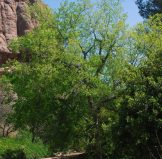
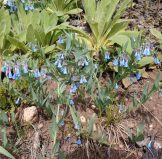
Scrophularia macrantha (Red Birds In A Tree) – This rare New Mexico wildflower was first brought into cultivation, and given its delightful common name, by the late, great plantsman David Salman, only a couple of decades ago. Subsequently promoted by the Plant Select program, it won the hearts of native plant gardeners and pollinator gardeners, and is a great favorite of hummingbirds. [Read More]

Our 32nd Gardening Season Begins March 1st!

February 5, 2024

As I write, the ground and rooftops are blanketed in snow, and the sun is streaming in the windows. Gotta love the Colorado winter! In less than a month, we’ll be open for our 32nd year as a nursery and garden center, and we are quite excited!

I don’t think we’ve ever had an easy year, but ‘easy’ isn’t an option in this business. So many aspects of running a nursery have never been predictable, and we’re always relating with thousands of details and challenges.

BUT we have a great crew and there are many things you can always count on finding when you visit Harlequin’s Gardens, and we hope you will appreciate the value you receive when you shop at our big little nursery.

For 31 years, we have always been committed to non-aggression, health and environmental stewardship in horticulture and all other spheres of Life. And this commitment will always continue!

We’ll never use toxic pesticides, fungicides, herbicides, or chemical fertilizers.

We are the best source for Colorado and regional Native Plants on the Front Range.

We have and will always specialize in Water-Thrifty plants, Native and Colorado-adapted plants and Pollinator-Supporting plants.

We are always broadening our plant offerings, often bringing into cultivation wonderful local wild plants that were previously unavailable in commerce. (*see below for examples)

Our staff, e-newsletters, classes, and hand-outs offer empowering, cutting-edge organic and environmental gardening advice and education gained from our 31 years of research and experience.

Our customer service team is exceptionally knowledgeable, helpful and accessible.

We grow most of our own plants and supplement with plants from other local and regional growers that never use neonicotinoids.

We grow our plants in our own carefully formulated potting soils that grow healthier, stronger, more resilient plants that will establish successfully into your garden.

Our pest management products are always non-toxic, child-safe and pollinator safe.

We compost and make our own powerful Compost Tea.

We aim to be a zero-waste business: we bag compost and mulches in returnable plastic bags that we reuse to reduce plastic in the environment. We also reuse nursery pots, and sell our compost tea in returnable/reusable jugs.

We offer superior, CO-specific resources and advice for supporting bees, butterflies, birds and other pollinators and beneficial insects.

We test and evaluate our soil products (composts, organic fertilizers, mulches and other amendments), and most of them are sourced locally.

We recycle and use recycled materials for our building projects.

Our greenhouses don’t use fossil fuels; our heat and energy come mostly from the Sun, with a little electricity from renewables. And this year we are installing a heat-pump system for our store!

We are located in unincorporated Boulder County, where sales taxes are only about half the rate of those in Front Range cities.

We support local growers, artists, artisans and musicians as well as non-profit environmental efforts.

We connect our customers with events and other educational and activist opportunities related to environmental, agricultural and horticultural issues.

———————————————————————————————————————————

Wild Plants we are Propagating in 2024.  We have our fingers crossed that good germination and growth on the unique native plants described below will allow us to bring them to you this season.

The plants we offer will contribute to a beautiful, thriving garden that will be a joy to behold, but they can also provide so much more than a pretty picture to look at. The ecosystem services that our plants provide add much more value to your gardens.

Celtis reticulata, courtesy Oregon State University

Celtis reticulata, Netleaf Hackberry
You may be familiar with the larger Celtis occidentalis or Western Hackberry, which makes an excellent long-lived, water-wise deciduous shade tree. Netleaf Hackberry is substantially smaller, fairly slow-growing to 15’ to 25’ with a spreading canopy, interesting sculpted bark, an attractive twisting branch pattern, rough green leaves and reddish brown or purple berries. The leaves support the caterpillars of Mourning Cloak and Hackberry Emperor butterflies and a number of moths, which in turn, along with the sweet berries, attract and feed many birds. In Colorado, Netleaf Hackberry occurs in the wild in the Front Range foothills and on the western edge of the plains. It is rarely available in nurseries. We’ve seen some handsome specimens growing around Lyons. Cold hardy and highly adaptable to many soils, moisture levels and exposures, it can be grown as a small to medium-sized tree that will not require any supplemental watering after initial establishment.

Mertensia lanceolata

Mertensia lanceolata, Prairie Bluebell, Languid Lady
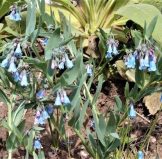
Dropping way down in scale, we are hoping for good germination on this lovely local spring wildflower that inhabits a wide range of Rocky Mountain habitats and elevations, from the plains to alpine habitats, in dry partial shade under deciduous shrubs and trees, on north-facing slopes, near rock outcroppings and in sunny meadows. In mid to late spring (May and June in Boulder) the delicate bell-shaped flowers nod from slender stems, opening from plum-colored buds and maturing to blue. The leaves are blue-green due to a waxy coating, with a prominent center vein. Prairie Bluebells are in the Borage family, prized for its many striking blue-flowered constituents. The plants can produce sizeable colonies, several feet across and can range from 6 ” to 14” tall. Prairie Bluebell goes dormant by early summer, dying back to its substantial roots.

Argemone hispida, courtesy Mik Kintgen

Argemone hispida, Rough Prickly Poppy
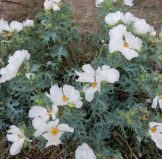
This is one of my favorite local wildflowers. It took me awhile to notice that it was different from the Prickly Poppies I had met before (Argemone polyanthemos), being more stout and shrubby, with grey-green foliage and much more dense, numerous and slender golden prickles on all parts, from stem to bud to seed-pod. The fabulous silky white flowers are just as big (4” wide) and just as stunning as the more commonly found Argemones, but the plant is more compact, up to perhaps 15” tall where I’ve seen it growing. They both grow in the same habitat, so Rough Prickly Poppy is also happy growing dry and hot, and blooms at the same time – May to August. Found in Colorado, New Mexico, Kansas, South Dakota and Wyoming.


Astragalus utahensis, courtesy James L. Reveal and the LadyBird Johnson Wildflower Center

Astragalus utahensis, Utah Milkvetch
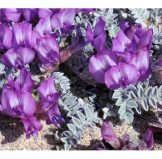
Utah milkvetch is in the legume family (Fabaceae). One finds quite a few plants in this family in the arid west. They are probably making life better for themselves and the plants around them by fixing nitrogen from the air and transferring it to their roots and the soil. Native to Utah and several adjacent states, this very pretty spring-blooming milkvetch is particularly abundant in the Wasatch Mountains. Its typical habitats include rocky hillsides, sagebrush openings, and pinyon-juniper areas. A rock garden, crevice garden, or the front of a Xeriscape garden with excellent drainage will suit it well. The plant is lovely even after bloom, with its wavy silvery pinnate leaves.


Yours in support of abundant Life,
Eve Reshetnik Brawner & Mikl Brawner

Ready Now

July 25, 2023

Geranium x cantabrigiense

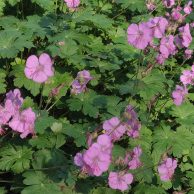
Remember Spring of 2023? Cool, rainy and cloudy? We had many thousands of plants coming along from seed, cuttings and plugs. And under these challenging conditions, some of them took a very long time to reach the point when they became ready for sale. But they’re ready now! And some of our best groundcover plants for dry shade or part sun, Plumbago and hardy Geraniums (Cranesbills) are among them!


Here’s a list of some of the great plants, including many native plants (noted with an asterisk), we now have in stock.

[Read More]

Another Spring Wildflower Ramble

June 6, 2023

Mertensia lanceolata

In spite of cloudy skies and not-so-distant rumblings of thunder, Mikl and I had another opportunity to ramble among the wildflowers last week. This time, we chose the easy Lichen Loop trail at Heil Ranch, just off Lefhand Canyon Road. It’s amazing how long we can take to walk a mere 1.3 miles! Our excuse was the amazingly rich floristic display brought on by the combination of copious rain and wood ash from the Calwood Fire.
[Read More]

Thanks, Volunteers!

January 17, 2023

Gary Meis teaching

Gary Meis teaching

Last Saturday a group of dedicated plantspeople came in from the cold to learn and volunteer with Harlequin’s Gardens’ expert propagator Gary Meis. We’re passing a few of his native plant seeding and propagation tips along to you.

[Read More]

Supporting our Colorado Trees

March 8, 2022

So they can support us!

Last Friday Denver Botanic Gardens hosted a day-long conference on Tree Diversity. This timely subject arises because of the importance of trees to the livability of our cities and suburbs and the degree to which the effects of Climate Change have already begun to affect our urban forest. Trees help cool everything from our gardens and patios and parking lots to our cities and our planet. With stresses like sudden, dramatic temperature changes, drought, and severe windstorms, plus the devastation wrought by the Emerald Ash Borer to our millions of Ash trees, it’s time to re-evaluate the limited palette of trees we’ve been planting for many decades, and investigate new, more resilient possibilities.  [Read More]

Boulder County’s First Botanic Garden!

September 7, 2021

In mid-August, Mikl and Eve had the pleasure of visiting the beautiful, newly created and planted Rocky Mountain Botanic Gardens in central Lyons, CO. Envisioned and designed by herbalist, botanist, and educator Garima Fairfax (a beloved former Harlequin’s staffer!) and brought to fruition with a team of dedicated volunteers and grant money, the non-profit botanic garden is a delightful and educational display of native annuals, perennials, shrubs, vines, and trees. It is easily accessed along popular walking and cycling trails. [Read More]
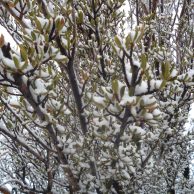
Solstice Cheer from the Garden

December 15, 2020

Attractive Evergreens for Colorado Gardens
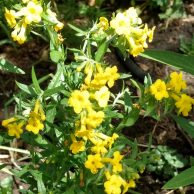
At the time of the Winter Solstice, we can be grateful for the evergreens in our Colorado gardens. Not every region of the temperate northern hemisphere can grow so many different beautiful plants with year-round presence.

There are so many evergreen (and eversilver, everblue, red and purple) hardy perennials, groundcovers, shrubs, herbs, and trees (and not just conifers!) we can grow here. They go above and beyond in their service as ornamental plants in all four seasons. [Read More]

Mother Nature’s Dryland Natives

September 1, 2020

On our hikes, it seems we’re often exclaiming, “What a beautiful plant combination!”.  Mother Nature’s inherent beauty and functional placement provide an amazing guide and inspiration for what we can create in our home garden or ecosystem. Mother Nature also helps guide us on how we can best support our pollinators.

In the new Harvest 2020 issue of Colorado Gardener (with a striking mushroom cover photo!), Mikl writes in ‘Blooming Without a Care’ about a selection of wonderful lesser-known dryland native wildflowers that can also be very successful garden plants in our semi-arid climate. [Read More]

sidebar

Blog Sidebar

Sign-up for E-Newsletters!

Sign-up for our weekly e-newsletters to receive empowering gardening tips, ecological insights, and to keep up on happenings at Harlequin’s Gardens — such as flash sales and “just in” plants. We never share customer’s addresses!

We do not ship plants!

Our plants are for sale ONLY at our Boulder location. We DO NOT ship plants or any other products.  Come visit us!

Hours by Season

MARCH HOURS
Thursday-Sunday, 9AM-5PM

STARTING APRIL 1
Tuesday-Sunday, 9AM-5PM


Footer

Contact Us

303-939-9403 (Retail)
staff@harlequinsgardens.com

4795 North 26th St
Boulder, CO 80301

Sign-up for E-Newsletters!

Sign-up for our weekly e-newsletters to receive empowering gardening tips, ecological insights, and to keep up on happenings at Harlequin’s Gardens — such as flash sales and “just in” plants. We never share customer’s addresses!

Map

Our Hours

Mondays, CLOSED

JANUARY-FEBRUARY HOURS:
Thursday-Saturday, 10AM-4PM

MARCH HOURS:
Thursday-Sunday, 9AM-5PM

APRIL-SEPTEMBER HOURS:
Tuesday-Sunday, 9AM-5PM

OCTOBER HOURS:
Thursday-Sunday, 9AM-5PM

Closing after Nov. 1

The plants we grow are organically grown. All the plants we sell are free of bee-killing neonicotinoid pesticides.