
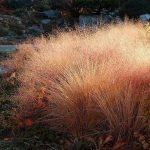
Undaunted Ruby Muhly
We often recognize grasses for their ornamental attributes – textural diversity, dynamic, flowing movement in the breeze, reflecting the dancing light, seasonal transitions, summer screening of unsightly areas, as well as their value in providing food and habitat for wildlife. Large grasses and groupings of smaller ones can share heavily-mulched, low-water, low-maintenance beds with shrubs for plant diversity and visual interest. Grasses also hold the soil, and enrich it, too.
Harlequin’s Gardens carries many clump-forming grasses that are well suited for the residential or public landscapes, and some of our in-stock favorites are shared below. But first, a refresher on three main types of grasses: cool season, warm season, and evergreen.
COOL-SEASON: Already up and green by March, cool-season grasses make active growth in cool weather until it gets hot. They can be kept green through summer by watering, but otherwise they go dormant until the fall, when some of them may begin growing again. Most bloom in June, but a few wait until late summer. Because they begin growing so early in the year, they are subject to being demolished by rabbits. People with resident rabbit populations should choose warm-season grasses instead. Cut cool-season grasses back to 2-3” inches tall in February, before they start their active growth, so light can penetrate the entire clump.
WARM-SEASON: Most grasses grown in this area are warm-season grasses. Many of our native grasses, and many of the most popular grasses for our area are Warm Season grasses. Wait until late March or early April to cut back warm season grasses. Cut as low as you can, ideally 2-3”, so light can penetrate into the entire clump.
EVERGREEN: Remain mostly green through the year and do not need to be cut back. To cleanthem up in spring, gently ‘comb’ out old dry blades with a hand rake.
Following are some of our favorite ornamental grasses that are in stock now, and available for your gardens.
COOL SEASON GRASSES
Calamagrostis acutiflora ‘Karl Foerster’s’ (Karl Foerster’s Feather Reed Grass)
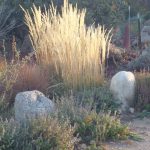
Karl Foerster grass
The most popular and over-used ornamental grass, for good reason. Medium sized (to 4’ tall), very erect form, easy to grow and highly adaptable to everything but shade, very durable flower/seed heads remain attractive all summer, fall and winter. No fall foliage color. Cut down in early February. Try to avoid plantings that look like rows of soldiers standing at attention! Hardy to Zone 4.
Calamagrostis brachytricha (Korean Feather Reed Grass)
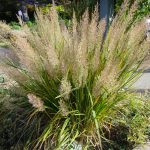
Korean Feather Reed
To 3’ or 4’ tall, with a graceful fountain-like or mounded shape, and waits until the mid to late summer to flower. Can take some shade. Very pretty, with pinkish plumes that dry tan. No fall color. Plant Select. Should be used more. Hardy to Zone 4.
WARM SEASON GRASSES
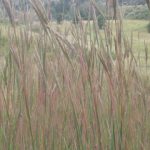
Big Bluestem
Andropogon gerardii (Big Bluestem)
Native! Big Bluestem is taller and has a wider blade than Little Bluestem and is somewhat upright but also arching. It also has attractive reddish and purple fall colors. Big Bluestem is one of the dominant components of the Tallgrass Prairies across the Great Plains, where it can reach 8’ in height. Here it can range from 2 to 5’ tall, depending on water and nutrients available. In late summer, Big Bluestem’s purplish red flowers appear in groups of three or six, which look like a turkey foot – hence the nickname: “Turkey Foot Grass”. The root system can extend down more than 10 feet. Each year, a third of these roots die, feeding soil microorganisms and opening up channels for water. This plant is drought tolerant once it’s established. Attracts birds and butterfly larvae. Plant in Full Sun. Hardy to Zone 4.
Bouteloua gracilis ‘Blonde Ambition’
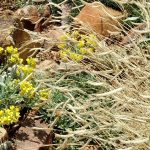
(Photo Credit: Plant Select)
‘Blonde Ambition’ was discovered in 2007 by David Salman of Santa Fe Greenhouses, who noticed an outstanding specimen growing within a stand of robust Hachita blue grama. At 28-32” it was taller and wider than the standard, its leaves were a bright blue-green and it was topped with a multitude of its distinctive flag-like flowers, although these were chartreuse, drying to pale ‘blonde’ rather than the usual black or brown, and they were held appealingly at a 90 degree angle to the leaves. The rigid stems popped back up after snowstorms, rather than remaining prostrate, so its season of attractiveness lasted well into the winter. It was apparent this was a plant that could stand on its own as an ornamental. Grow ‘Blonde Ambition’ in clay, loam, or sandy soils, with full sun and moderate to very low H2O. Hardy to Zone 4, 8,000’ elevation. (Photo Credit: Plant Select)
Chasmanthium latifolium (Northern Sea Oats, River Oats)
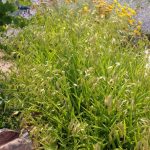
Northern Sea Oats
A US native, though not native here, this attractive and unique grass grows well in part shade. The wide, bright green blades emerge from the stems at many heights, giving it a slightly bamboo-like look. The pendulous seed clusters in late summer are composed of very attractive flat, plaited spikelets, starting out pale green, later turning tan. Foliage stays green until fall, when it turns yellow. It will self-sow but is not difficult to control. Established clumps will tolerate dry conditions, but thrive with water once a week. Hardy to Zone 3.
Panicum virgatum (Switchgrass)

Panicum virgatum (Switch Grass)
Native! Switchgrass was an important component of the Tallgrass Prairie. It tolerates a wide range of soils, including dry ones, but prefers moist soils that are not too rich in nitrogen, and grows best in full sun. Here it grows to about 3’ tall and wide, topped in midsummer by finely-textured pinkish flower panicles that hover over the foliage like an airy cloud. Seed plumes turn beige and persist well into winter, providing an excellent seed source for songbirds. Fall foliage color is yellow, but selections like ‘Shenandoah’ develop beautiful deep red and purple foliage color in late summer. Salt-tolerant. Hardy to Zone 2.
Schizachyrium (Andropogon) scoparium (Little Bluestem)

Standing Ovation (Plant Select®)
Native! Little Bluestem is very erect to 24”-30” with fine foliage and blooms in late summer-early fall. Blooms turn white and catch the early morning and late afternoon sun beautifully when back-lit. The foliage turns copper and looks good for a long time. Very drought-tolerant. Currently, we have two forms: Plant Select’s ‘Standing Ovation’ selection, featuring very upright form and exceptional fall colors of deep red and purple, and ‘Blaze’, which is the form commonly found in the wild here. Hardy to Zone 3.
Sporobolis wrightii (Giant Sacaton, Wright’s Sacaton)
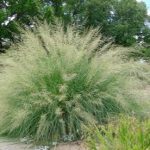
Sporobolis wrightii, Giant Sacaton
Native! Comes up earlier in spring than most other warm season grasses and also flowers earlier. Giant Sacaton is a ‘warm-season’ grass, meaning that it begins new growth each year when the soil has warmed up, usually in mid to late April. The impressive clump of 3/8”-wide arching, medium green blades reaches 4 to 5’ in height and 6’ in width. By July, it has sent up a generous spray of feathery plumes that can reach 8’ tall, and remain attractive into the winter months. Plant in full to partial sun. Cut to the ground in February or March. Hardy to zone 5.
Sporobolis heterolepis (Prairie Dropseed)

Sporobolis heterolepis (Prairie Dropseed)
Native! A lovely small grass found here in the foothills and eastward across the Western prairies. Growing to 1-2’ tall and wide, it makes an elegant, fine-textured, emerald green fountain, suitable in many garden styles. The fine-textured plumes that rise above the foliage clump are
attractive in bloom and in seed, and are favored by songbirds. The inflorescences are pleasantly fragrant – some say they smell like burnt buttered popcorn. Plains Indian tribes ground the seeds to make a tasty flour. Prairie Dropseed is also drought tolerant and turns a nice russet brown in fall. Hardy to Zone 4.
EVERGREEN GRASSES
Nasella (Stipa) tenuissima (Mexican Feather Grass)
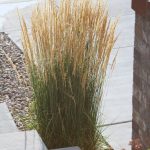
Mexican Feather
Also known as Ponytail Grass, this small grass, to 14” tall, has very fine-textured blades that make a ‘fountain’ of green. It can sometimes be evergreen. This grass may not be very long-lived, but will replace itself with seedlings, which can be relocated when small. Hardy to Zone 5.
Additional Ornamental Grasses in stock NOW:
Miscanthus gracillimus – (Maiden Grass) – Not invasive in our climate, Maiden Grass does need moderate water but provides a most impressive, large and dense mound of rich green, graceful, slender foliage and a fall finish of impressive feathery plumes that make lovely arrangements in winter. Hardy to zone 5.
Calamagrostis ‘Avalanche’– A variegated brother of ‘Karl Foester’, with a narrow white stipe down the middle of each blade. Cool-season. Hardy to Zone 4.
Undaunted Ruby Muhly
Muhlenbergia reverchonii (Undaunted Ruby Muhly) A Plant Select introduction from Lauren Springer, this fine-textured, mounding warm-season grass is native to Texas. It grows to 16-20” tall and 24” wide, and thrives in full sun with moderate to low water. In fall a dense mist of tiny pink-purple
seeds hovers around and above the foliage, creating exceptional beauty, especially when grouped or massed. Hardy to Zone 5.
Sporobolus cryptandrus (Sand Dropseed) Sand Dropseed is one of the most widespread and ecologically important native grasses in North America – tough, adaptable perennial bunchgrass that thrives in open, sandy, and disturbed habitats across an enormous geographic range from the Pacific Coast to the eastern Great Plains, from Canada to Texas. This warm-season grass grows in dense tufts 2 to 5’ tall with distinctive, pyramid-shaped flower panicles that release vast quantities of tiny, nutritious seeds. Sand Dropseed is a cornerstone plant of the native grassland ecosystem and an outstanding choice for low-maintenance, wildlife-friendly landscapes throughout the arid and semi-arid West. For birds and small mammals, Sand Dropseed is an invaluable food source — its abundant, tiny seeds are highly nutritious and are eaten by Gambel’s Quail, Mourning Doves, Lark Buntings, Horned Larks, and dozens of other ground-feeding birds. The plant’s dense, clumping growth provides cover and nesting material for ground-nesting birds and small mammals.
Sand Dropseed’s adaptability is remarkable: it will grow in almost any open location and will spread rapidly by seed. Its tolerance of drought, poor sandy or gravelly soils, and temperatureextremes makes it one of the most broadly adaptable native grasses available.

Freeda
Harpochloa falx ’Freeda’ (‘Freeda’ Caterpillar Grass) A cold-hardy Plant Select introduction from the mountains of South Africa, this smaller grass, 18” to 24” tall and wide, looks similar to our native Blue Grama grass (‘Eyelash Grass’), but the pale ‘eyelashes’ or ‘caterpillars’ turn deep blackish brown in winter, making an arresting contrast with snow. Warm-season. Hardy to Zone 5.

Pennisetum orientale (Oriental Fountain Grass)
Penisetum orientale (Oriental Fountaingrass) is a large, warm-season, clump-forming, tufted perennial grass native to
regions spanning from North West Asia to North Africa. It blooms from early summer through fall, producing feathery, narrow flower wands that arch gracefully above the foliage. These panicles, initially pinkish, mature to light brown, adding visual interest to the landscape. The gray-green, arching leaves form a dense mound that remains attractive throughout the growing season. Its impressive drought tolerance and deer-resistant nature make it a practical choice for various garden settings. Additionally, the flower plumes are excellent for cutting, suitable for both fresh and dried arrangements. We’ve had Oriental Fountaingrass growing at Harlequin’s Gardens without irrigation or attention for decades.