
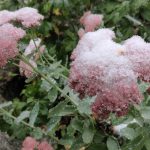
 Colorado gardeners know that the first hard frost date here varies wildly from year to year, and from the valleys to the high elevations. Here in the Boulder Valley we are expecting the temperature to make its first dip into the frigid zone tonight, with a prediction of 29 degrees, just one degree above ‘hard frost’. And our first snow is predicted for Thursday. This may translate into a lot of flower, fruit, and vegetable crops cut short, and a lot of work protecting vulnerable plants, harvesting, and preserving. How many of you spent the weekend making pesto, tomato sauce, pickles, jam, and flower bouquets? Here are our recommendations for cold weather and snow preparations.
COOL SEASON VEGGIES – To minimize damage, harvest leaves from your kale, chard, spinach, etc., then cover the remaining in-ground plants with a couple layers of Ensulate Row Cover fabric. Avoid using plastic sheeting directly on plants as it transfers cold to the foliage and fruit. Secure the Ensulate fabric with rocks, bricks, sandbags, and clothespins, especially on the windward side, to prevent the cold wind from getting underneath. Large over-turned plant pots, lined with bubble-wrap will suffice as well. especially for smaller
plants. In either case, the snow on top of the fabric and/or pots will also help to insulate the plant.
TOMATOES & WARM SEASON CROPS – Harvest tender annual/warm season veggies such as tomato, pepper, eggplant, tomatillo, basil, summer squash, bean, cucumber, etc. Unripened tomatoes can be placed on a windowsill to mature – so long as the tomato is showing at least some lightening of the green skin to pale green or white, it will likely ripen. Another option for tomato plants still bearing fruits: Pull the tomato plant and its roots out of the ground and hang it upside-down in a frost-free place such as a heated garage, where much of the fruit should continue to ripen.
WINTER SQUASH – If still on the stem, the fruits of winter squash and pumpkins should be fine through a frost but not a hard freeze; cover with Ensulate fabric and secure fabric edges with clothespins to prevent wind from opening the draping. If necessary, utilize hoops or poles to aid in draping over bulky plant material. Any curing squash and pumpkins should be moved to inside a hoop house, cold-frame, or garage.
ONIONS – Pull onions whose tops have fallen over and are pushing up through the soil. As with the squash, bring curing onions inside.
PERENNIALS – Harvest remaining flowers to enjoy indoors. Recent plantings that are not yet established and small perennials such as cyclamen can be covered with an overturned pot as shown above, or drape Ensulate fabric over a tomato cage to protect perennials or potted annuals.
SHRUBS & TREES – These in-leaf plants are the most vulnerable to damage as the wet and heavy snow can break their branches. To help prevent this, knock the snow off the plant periodically by pushing on the under-side of the limb with a light-weight rake rather than striking downward on the branch or plant. For small trees and large shrubs, you can grasp the trunk and gently shake the plant to remove a good portion of the snow. (Wearing a hood and looking down before the snow plummets are key to ensuring your comfort!)
SMALL SHRUBS – Valuable, young woody perennials and shrubs, such as Daphne, can be protected by covering with over-turned plant pots to help protect their branches from breaking. If a big pot is not available, a folding table can be erected over the plant that needs protection, or a sawhorse with a tarp over it to make a ‘tent’ with edges secured to the ground with rocks, bricks or pipes.