
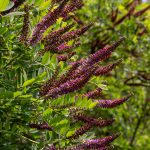
Amorpha fruticosa – False Indigo A Versatile Native Shrub
Leadplant has a little brother, Amorpha nana, but did you know that it also has a big sister? Like its kin, False Indigo is deciduous, and is a legume with deep branching roots that fix nitrogen from the air, enriching the fertility of the soil around it. You’ll find it growing in areas with relatively high water-tables or periodic flooding, such as Walden Ponds in east Boulder County.
Grown in full sun, it makes a densely twiggy and fine-textured shrub to about 4’ tall and wide, and grown under tall trees or in places shaded by high walls, it will be graceful, open and airy, and taller – up to 12’x 8’. Slender, smooth stems are gray, and the pinnately compound foliage is fine-textured, with dark green ½”-long oval leaflets that turn bright gold in autumn. The showy blooms arrive in late May or June, arranged in finger-like tapering spikes of tiny dark blue-purple florets with conspicuous orange stamens. These are visited by butterflies for their nectar, and bees as well, for pollen and nectar. Small bean pods ripen in late summer and autumn, and are enjoyed by many birds. False Indigo is cold-hardy to -30F, fast-growing and long-lived. It’s not fussy about soil, and tolerates high heat as long as it is receiving some moisture. Once it has built a good root system, False Indigo should thrive with two deep waterings per month. A lovely companion to Silver Buffaloberry, Golden Currant, Rocky Mountain Maple, Chokeberry, and New Mexico Privet.