• Skip to primary navigation
  • Skip to main content
  • Skip to primary sidebar
  • Skip to footer
Harlequins Gardens

Harlequins Gardens

Boulder's specialist in well-adapted plants

We’re currently open Tues-Sun, 9-5

Memberships & Gift Certificates – available online
See our seasonal hours and address below • Read our latest e-newsletter!

Help Support Our Mission: GoFundMe

  • Home
  • About
    • About Us
    • Staff
    • Display Gardens
    • Why the Name “Harlequin’s” Gardens?
    • Support Our Mission
    • Sustainability
    • Policy on Pesticides Including Neonicotinoids
    • Careers
  • What We Offer
    • Products
    • Plants
    • Gift Certificates
    • Membership
  • Plants
    • Annuals
    • Bulbs
    • Fruits
    • Groundcovers
    • Herbs
    • Natives
    • Ornamental Grasses
    • Perennials
      • Plants for Pollinators List
    • Roses
    • Vegetables
      • Tomato Starts
      • Pepper Starts
      • Other Vegetable Starts
      • Fall Vegetable Starts
      • Garlic
    • Xeriscape
  • Resources
    • Recommended Gardeners & Landscapers
    • Mikl’s Articles
    • Plant and Cultivation Information
    • Newsletters
    • Links
  • Garden Tours
  • Events
  • Classes
  • Blog
  • Wholesale
    • Wholesale Sales
    • Who Qualifies
    • Wholesale Pricing & Sizes
    • Wholesale Terms and Conditions
  • Contact
Home | native shrubs

native shrubs

Amorpha fruticosa – False Indigo  A Versatile Native Shrub

August 25, 2026

Amorpha fruticosa – False Indigo  A Versatile Native Shrub

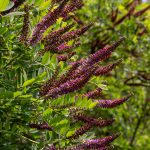
Leadplant has a little brother, Amorpha nana, but did you know that it also has a big sister? Like its kin, False Indigo is deciduous, and is a legume with deep branching roots that fix nitrogen from the air, enriching the fertility of the soil around it. You’ll find it growing in areas with relatively high water-tables or periodic flooding, such as Walden Ponds in east Boulder County.

Grown in full sun, it makes a densely twiggy and fine-textured shrub to about 4’ tall and wide, and grown under tall trees or in places shaded by high walls, it will be graceful, open and airy, and taller – up to 12’x 8’. Slender, smooth stems are gray, and the pinnately compound foliage is fine-textured, with dark green ½”-long oval leaflets that turn bright gold in autumn. The showy blooms arrive in late May or June, arranged in finger-like tapering spikes of tiny dark blue-purple florets with conspicuous orange stamens. These are visited by butterflies for their nectar, and bees as well, for pollen and nectar. Small bean pods ripen in late summer and autumn, and are enjoyed by many birds. False Indigo is cold-hardy to -30F, fast-growing and long-lived. It’s not fussy about soil, and tolerates high heat as long as it is receiving some moisture. Once it has built a good root system, False Indigo should thrive with two deep waterings per month. A lovely companion to Silver Buffaloberry, Golden Currant, Rocky Mountain Maple, Chokeberry, and New Mexico Privet.

Just in: Two Rare Native Shrubs

June 23, 2026

We just got in two plants we have had many requests for: come soon, supplies are limited.

Boulder Raspberry

Boulder Raspberry, Rubus deliciosus:  This lovely local native shrub is adorned with large single white blossoms that look similar to wild roses, blooming in May and June. Pollinators that are attracted to Boulder Raspberry are: Bumblebees, native solitary bees like metallic green sweat bees, mason bees and mining bees, also honey bees, lady bugs, butterflies and beneficial syrphid flies. It grows 3-5’ high and wide with arching stems. Although it is named Rubus deliciosus, it is neither a thorny raspberry, nor are the fruits delicious. But it is a beautiful shrub for the home landscape. It grows best in partial shade with water once a week.

Leadplant

Amorpha canescens, Silver Leadplant – This Colorado native plant fits into small water-wise landscapes, growing only 2’-4’ tall and wide. In June/July it blooms with showy spikes of purple flowers which are rich in both nectar and pollen. Pollinators include Bumblebees, metallic green sweat bees, plasterer bees, leaf-cutter bees, butterflies, beneficial wasps and is a host plant for butterflies. The small compound leaves add a lovely texture, and the plant is nitrogen-fixing.

Native Shrubs for the Garden and Landscape

May 19, 2026

Mikl with Desert willow

Desert willow in bloom

Harlequin’s Gardens is famous for our selection of Native Shrubs. Not only do we have them when few other nurseries do, but we know them and we have mature specimens planted in our display gardens. These woody plants that are so well adapted to Colorado conditions are often drought tolerant, low maintenance, bee and pollinator-supporting, wind-tolerant, cold-tolerant and good-looking. Like many shrubs, some benefit from a once-a-year pruning to remove dead flowers before they make seeds. This will make them more tolerant to drought and snow and wind, but seeds can be left for the birds and pruned late fall.

Native shrubs can be grown together for a very water-wise and low maintenance garden that is tied together visually with a fine woodchip mulch.

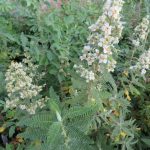
Fernbush (Chamaebatiaria millifolium) is a beautiful Plant Select® shrub that is usually 4’- 6’ tall and wide with fern-like leaves that come out in mid January or February. It is very tolerant of dry conditions, heat and bright sun. In summer, clusters of small white flowers cover the bush densely and often bloom a little more in fall. These flowers are extremely attractive to beneficial insects, especially native, non-aggressive wasps which help keep down populations of pests and are intent on pollen, not people. This shrub is tough enough for the back 40 and attractive enough for the front yard. It can be sheared (or pruned) lightly after blooming for a tidier appearance and to encourage rebloom. Fernbush is native to Idaho, Utah and northern Arizona.

Fernbush

Chilopsis linearis is called Desert Willow because it has narrow, willow-like leaves and is very drought-tolerant. It is a small tree 6’-15’ with an open structure and does not leaf out until May, even late May. It is related to Catalpa tree and Trumpet Vine. The orchid-like flowers are so surprising and breath-taking; ruffled, trumpet-shaped, pink to red-purple, striped purple inside. Chilopsis prefers dry, loose soils, but clay is OK if it is seldom watered. At night it is visited by hawkmoths and is scented of violets according to Bob Nold. He also says it “…is the toughest shrub that can be grown in our garden…I have never watered my plants.” The flowers bloom for a long time and are followed by narrow pods that are not messy. Chilopsis is native to New Mexico, Nevada and Utah. Books often say it is hardy to zone 7, but we have specimens over 10 years old at Harlequin’s and Denver Botanic Gardens has many older trees. Often, the flowering tips die and look better pruned off.

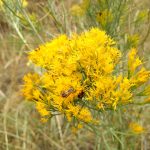
Dwarf blue rabbitbrush

Dwarf Rabbitbrush (Ericameria or Chrysothamnus) has been called The Gem of the Tribe. It is a compact shrub 1’-2’ high and 2’-3’ wide with short and narrow bluish leaves and clouds of golden yellow flowers in throughout autumn. The flowers are very attractive to pollinators; it is a crucial late-season food source, supplying nectar and pollen for native bees, honeybees, Monarch and other butterflies, moths and even hummingbirds. Once established, this shrub thrives with little or no watering. It also provides a welcome display of color in the late season and if it is sheared after flowering, will stay compact and attractive enough for the front yard. It is native near Harlequin’s in the open and dry high desert and steppe, and in much of Colorado.

Shrubs and Grasses this Weekend!

April 28, 2026

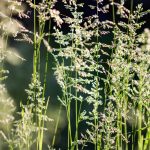
Tufted hairgrass

Trees:

Amelanchier alnifolia (native)

Shrubs:

Amelanchier alnifolia ‘Regent’ (native)
Peraphyllum microphyllum (native)
Prunus besseyi ‘Pawnee Buttes’ (native)
Prunus besseyi ‘Flatiron’ (native)
Syringa vulgaris – Common Lilac
Viburnum x ‘Sarcoxie’
Cotinus coggygria ‘Winecraft Black’ – Purple Smokebush

Raspberries:

Heritage and Polana red raspberries

Grasses:

Deschampsia caespitosa – Tufted Hairgrass (native)
Panicum virgatum ‘Shenandoah’ – Red Switchgrass
Schizachyrium scoparium ‘Prairie Blues’ – (native)

Perennials:

Sedum ‘Purple Emperor’

groundcover – Ephedra minima


sidebar

Blog Sidebar

Sign-up for E-Newsletters!

Sign-up for our weekly e-newsletters to receive empowering gardening tips, ecological insights, and to keep up on happenings at Harlequin’s Gardens — such as flash sales and “just in” plants. We never share customer’s addresses!

We do not ship plants!

Our plants are for sale ONLY at our Boulder location. We DO NOT ship plants or any other products.  Come visit us!

Hours by Season

MARCH HOURS
Thursday-Sunday, 9AM-5PM

STARTING APRIL 1
Tuesday-Sunday, 9AM-5PM


Footer

Contact Us

303-939-9403 (Retail)
staff@harlequinsgardens.com

4795 North 26th St
Boulder, CO 80301

Sign-up for E-Newsletters!

Sign-up for our weekly e-newsletters to receive empowering gardening tips, ecological insights, and to keep up on happenings at Harlequin’s Gardens — such as flash sales and “just in” plants. We never share customer’s addresses!

Map

Our Hours

Mondays, CLOSED

JANUARY-FEBRUARY HOURS:
Thursday-Saturday, 10AM-4PM

MARCH HOURS:
Thursday-Sunday, 9AM-5PM

APRIL-SEPTEMBER HOURS:
Tuesday-Sunday, 9AM-5PM

OCTOBER HOURS:
Thursday-Sunday, 9AM-5PM

Closing after Nov. 1

The plants we grow are organically grown. All the plants we sell are free of bee-killing neonicotinoid pesticides.