
Mikl with Desert willow

Desert willow in bloom
Harlequin’s Gardens is famous for our selection of Native Shrubs. Not only do we have them when few other nurseries do, but we know them and we have mature specimens planted in our display gardens. These woody plants that are so well adapted to Colorado conditions are often drought tolerant, low maintenance, bee and pollinator-supporting, wind-tolerant, cold-tolerant and good-looking. Like many shrubs, some benefit from a once-a-year pruning to remove dead flowers before they make seeds. This will make them more tolerant to drought and snow and wind, but seeds can be left for the birds and pruned late fall.
Native shrubs can be grown together for a very water-wise and low maintenance garden that is tied together visually with a fine woodchip mulch.
Fernbush (Chamaebatiaria millifolium) is a beautiful Plant Select® shrub that is usually 4’- 6’ tall and wide with fern-like leaves that come out in mid January or February. It is very tolerant of dry conditions, heat and bright sun. In summer, clusters of small white flowers cover the bush densely and often bloom a little more in fall. These flowers are extremely attractive to beneficial insects, especially native, non-aggressive wasps which help keep down populations of pests and are intent on pollen, not people. This shrub is tough enough for the back 40 and attractive enough for the front yard. It can be sheared (or pruned) lightly after blooming for a tidier appearance and to encourage rebloom. Fernbush is native to Idaho, Utah and northern Arizona.
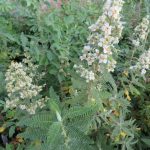
Fernbush
Chilopsis linearis is called Desert Willow because it has narrow, willow-like leaves and is very drought-tolerant. It is a small tree 6’-15’ with an open structure and does not leaf out until May, even late May. It is related to Catalpa tree and Trumpet Vine. The orchid-like flowers are so surprising and breath-taking; ruffled, trumpet-shaped, pink to red-purple, striped purple inside. Chilopsis prefers dry, loose soils, but clay is OK if it is seldom watered. At night it is visited by hawkmoths and is scented of violets according to Bob Nold. He also says it “…is the toughest shrub that can be grown in our garden…I have never watered my plants.” The flowers bloom for a long time and are followed by narrow pods that are not messy. Chilopsis is native to New Mexico, Nevada and Utah. Books often say it is hardy to zone 7, but we have specimens over 10 years old at Harlequin’s and Denver Botanic Gardens has many older trees. Often, the flowering tips die and look better pruned off.
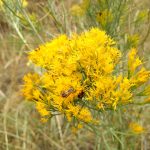
Dwarf blue rabbitbrush
Dwarf Rabbitbrush (Ericameria or Chrysothamnus) has been called The Gem of the Tribe. It is a compact shrub 1’-2’ high and 2’-3’ wide with short and narrow bluish leaves and clouds of golden yellow flowers in throughout autumn. The flowers are very attractive to pollinators; it is a crucial late-season food source, supplying nectar and pollen for native bees, honeybees, Monarch and other butterflies, moths and even hummingbirds. Once established, this shrub thrives with little or no watering. It also provides a welcome display of color in the late season and if it is sheared after flowering, will stay compact and attractive enough for the front yard. It is native near Harlequin’s in the open and dry high desert and steppe, and in much of Colorado.